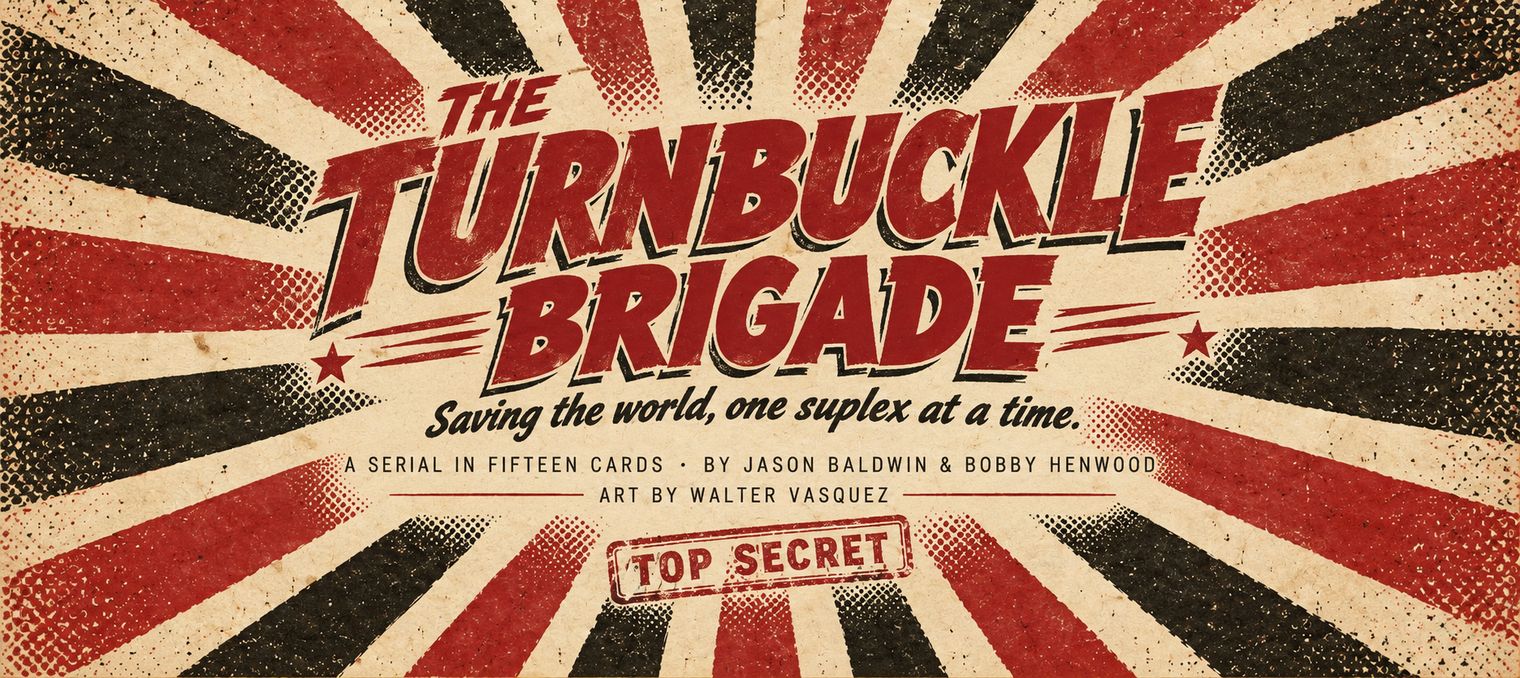
Chapter 23 — The Real Megingjörð
The battlefield was nothing but a hole now. What wasn’t smoke was water, and what wasn’t water was blood. The Valkyries—or Eyes of Thunder, as they called themselves—sat where they’d landed, most of them not getting up. A few, the lucky ones, rolled cigarettes or wiped gore from their arms. The rest counted wounds and waited to see if they’d get to die heroically or just cold.
Frank “The All-American” Zill sat on the edge of the ruined altar, feet dangling above a puddle that might have been cave water, might have been something worse. His knuckles were bruised purple, blood welling from the torn skin, and he stared at them with a look that said he’d expected different.
Bradley paced the cave, clutching what remained of his velvet tights together at the crotch. “I swear to God, the next time I get issued a uniform, I’m going to make damn sure it’s flame retardant,” he said. He picked a shard of glass from his thigh and tossed it over his shoulder. “At this rate, I’m going to have to wrestle in a barrel.”
Dottie ignored the drama, sitting with her back to the rock, tearing a strip from her shirt to wrap around her bleeding forearm. She used her teeth to knot it tight, then spat the blood onto the floor. “I’d kill for a first aid kit. Or a bottle of hooch.” She leaned her head back, rolled her one good eye at the ceiling, and said, “Hey, Zill. You planning on sitting there all day or you gonna help someone besides yourself?”
“Doesn’t matter,” Zill said, not looking up. “We lost.”
Wildman Fowler had rolled up his own sleeve and was busy tying off a tourniquet on a Valkyrie’s arm. The woman hissed through her teeth as he cinched it, then nodded in thanks. “You’ll keep the arm, maybe,” he said. “But don’t be an idiot. If you pass out, it’s coming off with a rock.”
The Valkyrie barked a laugh, then made a rude gesture and slumped against the wall, already dozing off.
Zill looked past the carnage, at the chest where the Megingjörð had been. The stone box was still there, its gold inlay shining under the ruined light, but the lid was ajar, empty but for a dusting of old bone. The world’s most expensive coffin. The world’s biggest joke.
“Metallgeist got what he came for,” Zill said, voice dry as the grit under his boots. “And we got nothing. Not even a runner-up medal.”
Bradley perched on a stalagmite, tried for a thoughtful look. “We could say we gave them a run for their money. I mean, we really sold the finish.”
“You think this is a show?” Dottie barked. “This is war, you peacock.”
Bradley shrugged. “Everything’s a show. Only the crowd changes.”
Zill flexed his fingers, watching the blood ooze from his knuckles, and remembered what it felt like to lose a match he’d been promised to win. Only now the stakes were a little higher than ticket sales.
He glanced at the scrap of Rivera’s cape, lying in the mud. No body. Just the torn cloth and a patch of blood, half-melted into the ice. For a second, Zill thought about picking it up, then didn’t.
Wildman finished with the Valkyrie and crossed to Zill, eyeing the battered hand. “You busted your grip. Can’t throw a proper punch until you ice it.”
“Doesn’t matter,” Zill repeated, but Wildman wasn’t listening. He pulled a canteen from his pack and poured a trickle over the knuckles, then yanked a handkerchief from his pocket and started binding them up.
“Don’t make me say thank you,” Zill muttered.
Wildman gave a tight grin. “Wouldn’t mean it, anyway.”
Bradley craned his head, scanning the room. “Where’s Reginleif? Figured she’d be here, gloating or sulking or something.”
“She’s not the sulking type,” Dottie said. “Probably up to her elbows in Nazi viscera.”
“Sounds fun,” said Wildman, but the words felt like they’d missed the mark.
They sat in silence, breathing in the coppery air. Zill felt the bruises blooming under his skin, the cold sinking in now that the adrenaline was gone. He looked at the Valkyrie nearest him—face streaked with dirt, hair clotted with blood, but eyes still alive. She watched him right back, unblinking.
Then footsteps, slow and deliberate. Reginleif stepped into the cave, flanked by her last surviving women. She wore the same battered leathers, but her white hair was out now, and her face—marked with blue tattoos and fresh cuts—looked older, somehow, but also lighter.
She didn’t go for the chest. Instead, she walked to Zill and sat cross-legged on the stone beside him.
“And yet,” Reginleif said, voice low, “it is not the end.”
Zill stared. “I watched him take the belt. Watched you try to stop him. Pretty sure it’s over.”
Reginleif’s lips quirked in something that might have been a smile. “You think we trust every maniac with a mythology book to guard the real thing?” She gestured, and one of her women appeared at her side, holding a cloth bundle. Reginleif took it, careful and precise, and set it on the ground.
Inside was a second belt. Not gold, not even silver—just old, dark leather, studded with iron rings and smelling of sweat and time.
“Is this a joke?” Bradley said. “I’ve seen better belts at a pawn shop.”
Reginleif looked at him with pity. “Only the worthy see the truth.”
Wildman reached for the belt, ran his thumb over the leather. “It’s the real deal,” he said, almost reverent. “Older than any of us. Maybe older than the stories.”
Dottie scoffed. “If it’s real, why let the Nazis take the shiny one?”
“Because they want to believe in the legend, not the responsibility,” Reginleif said. “The gold belt is a curse. It eats men alive. This—” she held up the ugly, ancient thing—“this gives only what you bring to it. No more, no less.”
Zill looked at the belt, then at Reginleif. “You want us to take it,” he said, already tired of games.
She nodded. “You want to win, don’t you? Then play the long game.”
Bradley’s eyebrows went up. “We’re just supposed to walk into Berlin with this?”
Dottie grinned, blood on her teeth. “I like it. Classic switcheroo.”
Reginleif stood. “You’ve earned it. Even in defeat, you are not like the others. Take the belt. And whatever else you need. We will hold the cave. You go finish the match.”
Wildman tucked the belt into his pack, careful. “What about the rest of your people?”
Reginleif shrugged. “They’ll heal, or they won’t. This was never about survival.”
Zill felt the energy in the room shift. They’d lost, but maybe not for good.
Reginleif led them to the edge of the cave, where the waterfall hid a narrow passage. “Go,” she said. “And don’t look back.”
Bradley winked at her. “Not even for a rematch?”
She almost smiled again. “If you live, we’ll see.”
But before they went, Reginleif had one more door to open.
She led them down another tunnel, away from the pools and the silence of the dead. The air got warmer, the walls slick with years of horse sweat and old piss. The path dropped, then widened, and at the end the Brigade stopped cold.
It was a stable, but not like any they’d seen. The rock had been hollowed out centuries ago, the ceiling vaulted and black with smoke. There were four stalls, each occupied by a horse the color of arctic snow. They were huge, shoulders broad, manes streaming with beads and plaits. Their eyes were blue, and when they saw the Brigade, they stamped and tossed their heads like they were expecting a fight.
Dottie’s jaw dropped. “You have got to be shitting me.”
Bradley circled one, hand out. “I’ve seen racehorses in Saratoga. These things make Seabiscuit look like a Shetland pony.”
Wildman gave a low whistle. “Hell of a ride.”
Reginleif opened the nearest stall. The horse inside snorted, then knelt as if it understood. Reginleif gestured for Dottie to mount. “She answers to Sigrun. Do not insult her, or she will throw you.”
Dottie didn’t hesitate. She limped over, hauled herself onto the bare back. The horse straightened and shivered. Dottie grinned, feral. “Feels like cheating.”
The next stall went to Wildman. The horse eyed him, then nuzzled the front of his jacket. He stroked its muzzle, then swung up in a single, practiced motion. “This one’s called what?” he asked.
Reginleif looked at the ceiling. “Brynhildr. They are sisters.”
Zill and Bradley took the last two. Zill’s horse had scars on its chest and a chipped ear; it moved slow, deliberate, like it had been in more fights than it cared to count. Zill climbed up and patted the horse’s flank. “You got a name?” he asked.
Reginleif nodded. “Freki. He is the oldest.” She looked at Bradley, who hesitated in the stall. His horse sidestepped, refusing to make it easy. Bradley tried to bribe it with a stick of gum. The horse sneered, then licked his hand with a tongue the color of raw steak.
“Go on,” Reginleif said. “He is yours.”
Bradley tried a couple of times before he stuck the landing. “He’s a bastard,” he said, clutching the mane.
“She is a bastard,” Reginleif corrected. “Her name is Hilda.”
The horses snorted and pawed the stone, the echo bouncing through the cave.
Zill looked at Reginleif. “These things actually run?”
She grinned. “They will get you there. Faster than any machine.”
Dottie said, “What about the chariot?” She pointed at the corner, where a war chariot sat in the shadows. The wood was black and gold, the wheels rimmed with iron, and a pair of carved wolf heads decorated the yoke.
Reginleif shrugged. “Only if you are feeling dramatic.”
Wildman grinned, teeth bright in the gloom. “Is there another way to do this?”
Bradley shot his hand up. “I vote chariot.”
Zill looked at the horses, at his team, and then at the Megingjörð. “Let’s go get our goddamn belt back.”
Reginleif walked to the exit, unbarred a massive oak door, and swung it open. The outside was all snow and moonlight, and the cold hit like a punch. The Brigade rolled the chariot out, hitched the horses in less than a minute, and climbed aboard: Dottie took the reins, Wildman and Zill flanked her, and Bradley, ever the showman, stood at the back with both hands on the frame.
Reginleif watched them line up, then took a step back. “Good luck,” she said. “Do not return unless you have ended this.”
Wildman flicked the reins. The horses pulled as one, and the chariot shot forward, spitting snow behind them. Dottie whooped. Bradley screamed, “This is the best day of my life!” and Zill, for once, just smiled.
Chapter 24 — The Chariot
The day cracked open with a scream of wind and the sour taste of gunpowder still stuck to the world’s teeth. The Norwegian coast lay gutted, every cove full of bones and driftwood, the sky the same dull gray as the grave. Dawn found Dr. Viktor Metallgeist hunched on a ledge above the fjord, eyes red, hands trembling on the Megingjörð—Thor’s belt, bright and gold as the first lie ever told.
Behind him, the last three Eisen Verfolger crawled from the mouth of the tunnel, coats caked with mud and god-knows-what. Their masks were dented, lenses cracked from the cave-in. Nobody spoke. One by one, they staggered toward the battered Opel Blitz waiting in the fog. The truck coughed blue smoke, idling, as if it too hated being awake this early.
Two motorcycles—a pair of black Zündapps—stood like hungry dogs beside the truck. The Verfolger split without needing orders: One swung onto each bike, the last one shouldering his rifle and climbing into the truck’s cab. Metallgeist yanked open the passenger door and hauled himself in. He cradled the belt in his lap, eyes never leaving the horizon.
“Go,” he said, voice ragged. “No stops.”
The driver nodded, clicked his heels, and hit the gas. The truck spat gravel, and the motorcycles peeled after it, headlamps carving yellow cones through the mist. For a moment, they were the only moving things left on this stretch of dead coastline.
In the rearview, the tunnel yawned, black and wet as a gun barrel. For a few blessed miles, it looked like the world might just let the Nazis get away with it.
They followed the shore road, winding and slick, sometimes inches from a straight drop into the saltwater. The snow had melted just enough to make the pavement a booby trap. The bikes weaved in and out, keeping pace, covering the truck from both sides.
Inside, Metallgeist sweated. The Megingjörð was heavier than it looked, and he was sure it moved when he blinked. He pulled it tighter to his chest, knuckles gone waxy and pale. “Keep an eye out,” he hissed. “They are not finished.”
The driver grunted, all focus.
Half a klick later, the road bent away from the water, passing a shack that looked like it had been lost in time or abandoned by a lunatic. The front of the shack was boarded with railroad ties and planks, big enough to seal a cave mouth.
“Slow,” Metallgeist ordered.
The truck dropped speed. The first Zündapp passed the boards, scanning for movement. Nothing.
Then the world exploded.
The shack detonated in a fan of splinters. Four white horses tore out, all muscle and frost and foam, pulling an ancient chariot that should have belonged in a myth, not on a Nazi-occupied highway. Two men stood at the yoke: Zill, eyes black and jaw set, and Wildman Fowler, grinning like he’d invented war. Bradley and Dottie braced on the crossbar, arms locked, teeth bared.
“Scheiße!” The driver screamed it and jerked the wheel hard. The truck fishtailed. Both Zündapp riders spun to see what new hell had come for them.
Metallgeist was already out the window, firing his Luger. The first shot went wide. The second pinged off a horse’s tack. The third found Zill’s ear—stripped the lobe to meat, sent blood down his neck. Zill barely blinked.
The chariot hammered the pavement, closing ground. The horses were monsters, their hooves eating distance, breath pouring steam in the morning air. Dottie leaned out, glass eye shining, and howled.
Bradley, never to be outdone, picked up a length of chain and whirled it overhead. “Try this, you Nazi pricks!” he shouted, letting it fly. It missed, but the chain caught one Verfolger in the face, shattering a lens.
The truck and bikes tried to split formation, but the chariot forced them tight to the cliff wall. Zill drove the team hard, steering with one arm, the other pressed to his bleeding ear.
Metallgeist shot again and again, emptying the Luger. He hit nothing. “Kill them!” he screamed, voice an octave higher than he would ever admit.
The next mile was a killing ground. The truck swerved, motorcycles flanking, the chariot gunning down the centerline like a missile from Odin’s own hangover. Zill wiped his blood on the sleeve of his jacket, mouth set in a line of pure hate.
The Turnbuckle Brigade was loose, and they were not coming for a rematch.
They were coming for blood.
The road curled like a noose around the fjord. Up ahead, a fork—left into the forest, right up the coast. Metallgeist, squinting into the wind, jabbed a finger at the left-hand turn and barked a code to the Verfolger: “Abzweigung! Aufteilen!” The first Zündapp peeled left, tires screaming. The second followed, engine howling. The truck lurched right, headed for open ground.
On the chariot, Dottie drew the sword Reginleif had pressed into her hands. It was big, iron, old as hell and sharp as her temper. She braced a foot on the axle, swung at the harness, and with a single slash, sheared the lead horses free.
“Bradley! Mount up!” she hollered.
Bradley, already halfway out of the chariot, launched himself onto the nearest horse, landing with a theatrical “Ha!” Dottie followed, glass eye catching the dawn. Her horse bucked, then found its stride. They galloped after the fleeing motorcycles, hooves tearing up blacktop and mud.
“We’ll take the bikes!” Dottie screamed back, voice bouncing off the cliffs.
Zill, still dripping blood from his ear, watched them go with a grunt. “Showoffs,” he said.
Wildman spat, wiped his nose on his sleeve, and leaned into the yoke. The lighter chariot surged ahead, picking up speed on the wet road. The horses ran like devils—furious, terrified, free.
The truck ahead bucked and fishtailed, barely making the curve. Metallgeist hung out the passenger window, gun in both hands. He fired again and again, but the shots were wild, angry—he wasn’t aiming at the horses, just the men on the chariot.
A bullet tore through Wildman’s coat, nicked his arm. He didn’t flinch. “He’s desperate,” Wildman muttered.
Zill bared his teeth. “He’s cornered.”
The truck roared up a narrow pass, the chariot closing in. At the next turn, the driver lost it—the road slicked over with a skin of old ice. The Opel skidded, overcorrected, and plowed sideways into the trunk of a pine the size of a smokestack.
The world turned upside down.
The truck rolled, slammed onto its roof, bounced, then lay still. The driver was just a smear, one boot still wedged under the gas pedal.
Metallgeist flew through the windshield, arms pinwheeling, the belt clutched to his chest even as he tumbled end over end. He hit the ground and skidded twenty feet, trailing blood and spit.
Dottie’s horse ran like the world owed it a debt. It gained on the fleeing Zündapp, the motorcycle’s engine whining, the Nazi hunched so low his helmet looked welded to his spine. She gripped the Valkyrie sword between her teeth, both hands on the mane, and willed the animal faster. Behind her, Bradley clung to his own steed, one arm windmilling for balance, the other trying to work the throttle of an imaginary Harley.
The road pitched, dipped, threw up stones and frozen clods, but the horses barely noticed. The motorcycle didn’t stand a chance on the ruts—every bump sent the rider airborne. Dottie was on him in ten seconds flat.
She yanked the sword from her teeth, swung it once for the drama, then jammed it into the saddle.
“Hey, asshole!” she barked. The Nazi looked back, eyes wide behind his cracked goggles.
Dottie launched herself off the horse, a perfect spear of fury and bad decisions. She caught the rider by the collar, spun him halfway off the seat, and then, in a move she’d invented for a county fair grudge match, drove her forearm into his throat with a wet crack.
They tumbled across the gravel, locked together. Dottie came up first, spat blood, and planted a boot on the guy’s chest. She dropped her whole weight in an elbow, felt the sternum give, then rolled off, panting.
“Stay down,” she said, and the Nazi obliged.
Bradley saw the move, wanted in. He lined up his horse, kicked it hard, and tried to time his leap. He missed the bike by a good three feet, flew over the handlebars, and hit the pavement tailbone-first.
The noise was less a thud and more a whipcrack. “Son of a bitch!” he shrieked, bouncing like a hockey puck before landing face-first in a snowbank.
He looked up just in time to see the second motorcycle crest a rise, rider glancing back to savor the chaos.
What the Verfolger didn’t see—what nobody could have predicted—was the fishing village ahead. Just before the first house, a clothesline stretched from porch to pole, women’s laundry hung to dry. The Verfolger hit it at sixty kilometers an hour.
The line caught him at the neck, lifted him off the bike, and for a split second he hung there, spinning, arms flapping. The bike ghost-rode on, careened into a ditch, and burst into a spectacular, greasy fireball.
The Nazi landed flat on his back, wrapped in a tangle of floral print nightgowns and wool socks. He gasped, tried to claw the clothes off his face.
And back over the rise, where an engine had just died against a pine, something was crawling out of the wreck with gold in its fists.