Chapter 5 — The Slideshow
Frank Zill woke up on a concrete floor with a headache that felt like God's own hangover and no memory of how he'd gotten there. The fluorescent tubes overhead buzzed like angry wasps, the light so white it turned his eyeballs into two boiled eggs. He tried to sit up. His wrists screamed. Raw, red, rubbed to meat—like he'd been dragged somewhere by the arms. He looked at them, then at the room, then at his hands again, as if repetition might produce an explanation.
Nothing came.
The room was a box. Concrete walls, concrete floor, concrete ceiling. A steel table bolted to the center. Two steel chairs on one side, one on the other, all bolted too. No windows. One door, steel, with a slot at eye level and a lock that looked like it could stop a tank. The air tasted like bleach and old sweat, the kind of smell you got in holding cells and high school locker rooms. Military. Had to be.
The last thing he remembered was Sherri's place. The diner. Coffee that could strip paint, pie that could save a marriage, and Sherri herself, leaning on the counter, telling him he looked like forty miles of bad road. He'd been sitting in the booth by the window, nursing his third cup, thinking about absolutely nothing—the way you do when the world's already done its worst and you're just waiting for the check.
After that: blank. Like someone had taken scissors to the film reel.
"—and I'm telling you, if there is so much as a scratch on that belt, I will personally sue every branch of the United States government, including the post office!"
The voice hit Frank like a slap. He knew it before he turned. Benjamin "Breathtaking" Bradley sat across the table, wrists unmarked, hair only slightly mussed, jaw working at a hundred words a minute. The man looked like he'd been plucked from a magazine shoot and dropped into a dungeon. His ring jacket was gone, replaced by a rumpled dress shirt missing two buttons, but his posture was immaculate—shoulders back, chin up, as if the concrete box were a greenroom and cameras were about to roll.
"Bradley," Frank said. His throat felt like sandpaper.
Bradley stopped mid-sentence, pivoted, and pointed a manicured finger. "Zill. Good. You're awake. Now maybe you can help me explain to these idiots that I am the reigning National Wrestling Alliance Heavyweight Champion, and my belt is not government property."
Frank rubbed his eyes, then his jaw, then considered going back to sleep. "Where are we?"
"How should I know? I woke up an hour ago. There's no mirror, no phone, no room service. This is a nightmare." Bradley tugged at his collar, smoothing a wrinkle that didn't exist. "I had a photo shoot in Cleveland tomorrow. Do you have any idea what a cancellation does to my brand?"
"Your brand," Frank repeated, flat as a morgue slab.
"Yes, Frank. My brand. Some of us think about the future."
Frank's knuckles went white on the edge of the table. The screwjob was right there, sitting between them like a loaded gun—every rigged count, every backstage handshake, every time Bradley had smiled for the cameras while Frank ate the pin. He swallowed it. Not now. Not yet.
A sound from the corner. Frank turned.
The third man sat in the shadow where the fluorescent light didn't quite reach, back against the wall, knees drawn up, hands folded in his lap. He was enormous—shoulders like a rain barrel, neck like a fire hydrant—but he sat so still he could have been furniture. No tribal paint. No feathered headdress. No animal-skin vest or bone necklace. Just a big man in a wrinkled cotton shirt and trousers, hair cropped close, face shaved clean.
Frank almost didn't recognize him.
"Wildman?" he said.
The man in the corner raised his head. His eyes were calm, brown, ringed with the kind of fatigue that sleep couldn't fix. He looked like a philosophy professor who'd been asked to move a piano.
"Elston Fowler," he said, voice low and steady, the kind of voice that belonged in a library, not a cage match. He extended a hand, then seemed to realize the gesture was absurd and let it drop. "We've never actually been introduced. Not as ourselves."
Frank stared. The disconnect was grotesque—like watching a grizzly bear order tea. In the ring, the Borneo Wildman was a hurricane of paint and screams and flying elbows, a man who bit referees and howled at the moon and once threw a folding chair so hard it embedded in the announce table. Here, sitting cross-legged on a concrete floor, Elston Fowler looked like a man who read books for fun and worried about his cholesterol.
"You were there," Frank said. The words came out like a knife sliding from a sheath. "At the Garden. You were in on it."
Fowler's expression didn't change. "I was in the match, yes. But the finish wasn't my call. If you'd let me explain—"
"Explain what? How you held me down while they counted three? How the whole goddamn locker room watched and nobody said a word?"
Fowler inhaled, slow and careful, like a man defusing a bomb with his breath. "It's more complicated than that, Zill. The promoters—"
Frank didn't hear the rest. The rage was already moving, bypassing his brain and heading straight for his fists. He launched across the table, caught Fowler by the collar, and drove him back into the wall. The impact cracked the plaster. Fowler didn't fight back—just braced, absorbed, let Frank's momentum spend itself against his chest like a wave hitting a seawall.
Bradley scrambled sideways, chair screeching. "Jesus Christ, Zill!"
Frank cocked his fist. Fowler looked up at him, calm as a lake, and said, "Go ahead. But it won't change anything."
The steel door exploded inward.
Two soldiers came through first, rifles up, boots hammering the concrete. Behind them, two men in uniform: one built like a filing cabinet with a crew cut, the other lean, unremarkable, the kind of face you'd forget before you finished looking at it.
The lean one moved fast. He crossed the room in three steps, caught Frank's cocked arm at the wrist, twisted it behind his back, and drove him facedown onto the table in a single fluid motion. The grip was professional—not soldier-strong, not wrestler-strong, but something else entirely. Precise. Practiced. The kind of hold that came from a place where mistakes got people killed.
Frank's cheek hit the steel. He tasted blood.
"That's enough," the lean one said. His voice was flat, bored, like he'd done this a hundred times and was tired of the paperwork. The name tape on his chest read SMITH.
The big one—HAVERCHUCK, according to the stencil on his breast pocket—stepped forward, boots clicking, and surveyed the room with the exhausted disgust of a man who'd been handed a bag of cats and told to make them march.
"Gentlemen," Haverchuck said. The word dripped with contempt. "I'm Sergeant Harold Haverchuck, United States Army. This is Corporal Smith. You are currently sixty feet below a facility whose name you will never know, in a state you will never be told."
Bradley raised a finger. "I have rights—"
"You have nothing," Haverchuck cut him off, voice cold as a rifle barrel. "As of oh-four-hundred this morning, you three have been drafted into a special operation under the direct authority of the War Department. Your civilian lives are suspended. Your contracts, your bookings, your photo shoots—" he glanced at Bradley—"are irrelevant."
Smith released Frank's arm and stepped back, positioning himself near the door. Frank noticed the way he stood—weight balanced, eyes sweeping, hands loose at his sides. Not guarding. Assessing. The man watched the room like he was memorizing it for later.
Frank pushed himself off the table, wiped his mouth. "Drafted," he said.
Haverchuck nodded. "That's the polite word. The impolite word is 'conscripted.' Either way, choice was never part of the arrangement."
Fowler, still seated against the wall, rubbed the back of his neck where Frank had slammed him. "And if we refuse?"
Haverchuck looked at him the way you'd look at a dog that had learned to talk. "Then you'll spend the rest of the war in a cell that makes this one look like the Waldorf. Your call."
The room went quiet. The fluorescents buzzed. Smith watched them all, and said nothing, and Frank couldn't shake the feeling that the lean corporal was the most dangerous thing in the room.
# Scene 2
The corridor was the kind of place where hope went to die—long, narrow, lit by bulbs that gave off more heat than light, the walls lined with stenciled signs that meant nothing to civilians and everything to the men who'd built this tomb. SECTION 4-C. AUTHORIZED PERSONNEL ONLY. NO PHOTOGRAPHY. The wrestlers shuffled between two rows of armed guards, boots echoing on poured concrete that smelled like it had been mixed with despair.
Frank walked with his hands at his sides, wrists still burning, jaw still sore from the table. Bradley limped behind him, muttering about habeas corpus and talent agents. Fowler brought up the rear, silent, head swiveling to read every sign and number they passed as if committing the layout to memory.
Smith led the procession. Frank watched him move and felt something cold settle in his gut. The corporal didn't walk like a soldier. Soldiers marched. Smith flowed. His eyes never stopped—they swept left at every junction, measured the distance to each door, clocked the position of every overhead light and fire extinguisher. At one point, passing a T-intersection, Smith paused for a half-beat, just long enough to check both angles before waving them forward. His right hand stayed close to his hip, fingers loose, not resting on his sidearm but aware of it the way a pianist is aware of middle C.
Frank had spent twenty years reading opponents. Every twitch, every tell, every unconscious lean that gave away the next move. Smith read like a man trained to be invisible, and that was the kind of man who made Frank nervous.
They stopped at a heavy door marked BRIEFING ROOM 7. Haverchuck produced a key, worked the lock, and pushed the door open with his shoulder. The room beyond was larger than the cell but no friendlier. A long metal table dominated the center, flanked by folding chairs. The walls were papered with maps—big ones, tacked at the corners, curling at the edges, covered in colored pins and lengths of string connecting cities to coastlines to mountain ranges. Europe, mostly. Norway jumped out in red ink, the coastline bristling with annotations and circled coordinates. Someone had drawn arrows converging on a point in the interior, the lines sharp and deliberate as surgical cuts.
A projector squatted on a wheeled cart at the far end, its power cord snaking across the floor like a vein. The screen behind it was already pulled down, white and blank and waiting.
"Sit," Haverchuck said.
They sat. The chairs were cold. Bradley made a face, shifted, and said, "If this is about taxes, I have an accountant."
Nobody laughed.
Smith positioned himself at the back of the room, near the door but not in front of it—beside it, where he could see everyone's hands and still reach the hallway in two steps. He folded his arms and went still, face blank as a playing card.
Haverchuck killed the overhead light. The projector hummed to life, throwing a rectangle of sickly yellow onto the screen that resolved into a grainy photograph: a group of men in SS uniforms standing before a ruined church, shovels in hand, smiles wide as county fair ribbons.
"What you are about to hear is classified above your pay grade, above my pay grade, and above the pay grade of most generals in the European theater," Haverchuck said. His voice had the cadence of a man who'd given this speech before and hated it more each time. "In 1935, the Nazi Party established a research division called the Ahnenerbe. Their stated mission was to study the ancestral heritage of the Germanic race. Their actual mission—" he clicked the projector, and the image changed to a blurry shot of a stone tablet covered in runic inscriptions—"was to find objects of mythological power and weaponize them."
The next slide: a woodcut, old as sin, depicting a broad-chested figure in armor, a belt cinched at the waist, lightning branching from both fists.
"This," Haverchuck said, tapping the screen with a pointer that looked like it had been borrowed from a schoolteacher, "is the Megingjörð. In Norse mythology, it was the belt of Thor—said to double the strength of whoever wore it. The Ahnenerbe has spent six years and an ungodly amount of the Reich's money looking for it."
He let that sit. The projector clicked again. A map of southern Norway filled the screen, dotted with symbols Frank didn't recognize—military shorthand, supply routes, a cluster of red Xs near the coast.
"Six months ago, Nazi intelligence intercepted a lead. They believe the belt is hidden somewhere in the Oslofjord region, guarded by a local cult with ties to old Norse traditions. They've assembled a team—scientists, soldiers, and at least one individual with combat experience we have reason to take very seriously."
Another click. A photograph, dark and slightly out of focus: a man in a gas mask, shoulders hunched, standing in front of a bombed-out building. The image was unsettling in a way that went beyond the mask—something about the posture, the stillness, the sense that the camera had caught something that didn't want to be seen.
Fowler leaned forward, eyes narrowing. Frank noticed.
Bradley's laugh cut through the room like a bottle breaking on tile.
"You kidnapped us for a fairy tale?" he said, voice bouncing off the concrete walls, every syllable pitched for the back row of an arena. "Thor's belt? Magic powers? What's next, you going to ask us to find the Holy Grail?"
Haverchuck didn't flinch. He didn't even look at Bradley. He just clicked the projector again, and the image shifted to a still from a film reel—a man in a lab coat holding something that glowed, the light washing his features into a ghoulish mask.
"The Nazis don't think it's a fairy tale, Mr. Bradley. And they've killed eleven people to prove it."
The room went quiet. Bradley's mouth stayed open for a second, then closed.
Haverchuck continued, voice dropping half a register. "The War Department has determined that conventional military assets cannot be deployed to this region without alerting the German garrison. What we need is a small team—physically capable, accustomed to performing under extreme pressure, and completely deniable."
He let the word hang. Deniable. It tasted like a contract nobody wanted to sign.
"Professional wrestlers," Fowler said, quiet as a closing book.
Haverchuck looked at him, the first time he'd shown anything close to acknowledgment. "Professional wrestlers. Men whose disappearance from civilian life can be explained by the nature of their profession. Men who travel constantly, who have no fixed address, who the public expects to vanish between events."
Frank felt the pieces click together in his head, ugly and precise. "You picked us because nobody would notice we're gone."
Haverchuck's jaw tightened. "I picked you because you were available, you're in peak physical condition, and frankly, Mr. Zill, because the alternative candidates are either dead or deployed."
Smith shifted at the back of the room. Just a slight adjustment of weight, left foot to right, but Frank caught it. The corporal's eyes had moved—not to Haverchuck, not to the screen, but to the maps on the wall. Specifically, to the Norwegian coastline. His gaze traced the red arrows, lingered on the cluster of Xs, then returned to neutral so fast it might have been imagined.
But Frank didn't imagine things. Not the important ones.
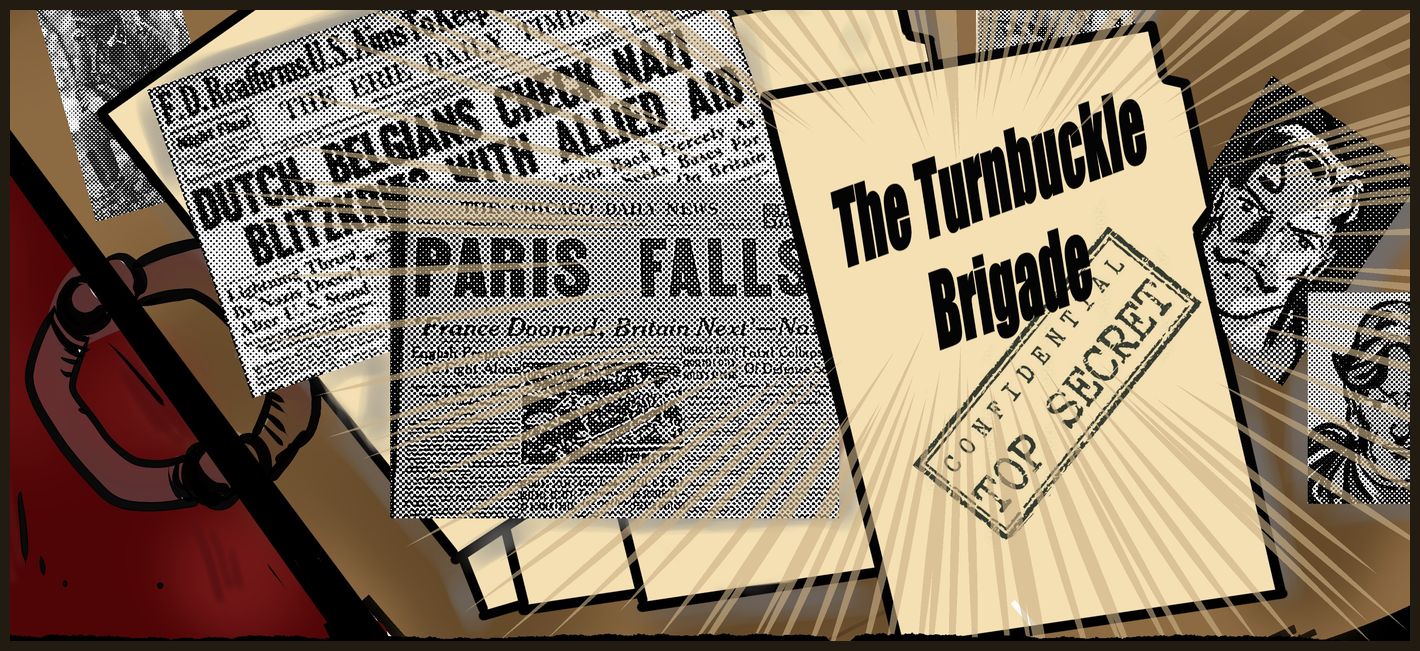
Haverchuck killed the projector. The overhead light snapped back on, harsh and unforgiving, turning everyone into suspects. He reached beneath the table and produced a manila folder, thick as a sandwich, its edges dog-eared, its surface stamped with security classifications in black ink.
He dropped it on the table. The sound was a gunshot in the small room.
Across the front, in block letters the color of arterial blood: **THE TURNBUCKLE BRIGADE**.
Frank stared at it. Bradley stared at it. Fowler reached out, ran a finger across the letters, and pulled his hand back as if the ink were hot.
"Catchy," Fowler said.
Haverchuck's face didn't move. "You ship out in forty-eight hours. Everything you need to know is in that folder. Read it, memorize it, and then forget you ever saw it."
He turned and walked out. Smith followed, pausing at the door just long enough to sweep the room one final time—table, chairs, faces, folder—then pulled the door shut behind him. The lock engaged with a sound like a coffin lid closing.
The three wrestlers sat in the fluorescent glare, the folder between them, the maps of Norway staring down from every wall.
Bradley broke first. "I'm not doing this," he said.
Frank pulled the folder toward him, flipped it open, and started reading.
Fowler leaned back, crossed his arms, and stared at the ceiling as if it owed him answers.
Outside, the corridor was silent. Somewhere above them, the world kept turning, oblivious to the show that was about to begin.
Chapter 6 — The General
They came back twelve hours later, or maybe it was twenty—hard to tell in a place where the lights never changed and the clocks had been removed on purpose. The briefing room had been rearranged. The folding chairs were still cold, still bolted to nothing, but someone had added a second projector on a rolling cart and a pull-down screen that looked like it had been stolen from a junior high. The overhead fluorescents were off. In their place, the projector threw a pale rectangle onto the screen, the color of old bone, and the room smelled like hot dust and machine oil.
Frank Zill took the same chair he'd had before—back row, far left, where he could see the door and the screen without turning his head. He'd read the folder twice. Once fast, looking for the catch. Once slow, looking for the lie. He hadn't found either, which bothered him more than both.
Bradley took the center, naturally. He sat with one leg crossed over the other, arms draped over the chair backs to either side, occupying three seats' worth of space with the easy entitlement of a man who'd never been told no by anyone who mattered. The folder sat on the floor by his foot, barely creased. He'd flipped through it the way a man flips through a magazine at the dentist—looking at the pictures, skipping the fine print.
Fowler had positioned himself in the front row, spine straight, hands folded on the table. The folder in front of him was thick with dog-ears, margin notes penciled in a hand so small you'd need a magnifying glass to read them. His face had the focused calm of a man who'd just memorized something important and was now deciding what to do about it.
Smith stood at the back of the room, near the door, in the exact same spot as before. Same posture, same blank face, same loose hands. He might as well have been bolted to the wall. The only difference was a fresh cup of coffee in his left hand, which he hadn't drunk from once. It was a prop, Frank decided. Something to hold so his hands wouldn't seem empty.
Haverchuck came in without ceremony, trailing two aides who carried a stack of file boxes and the grim air of men who'd been up since before the sun. The sergeant looked like he'd aged a year overnight—the skin under his eyes had gone from grey to purple, and his jaw worked a piece of gum with the mechanical fury of a man who'd quit smoking and hadn't forgiven the world for it.
"You read the folder," Haverchuck said. It wasn't a question.
"Cover to cover," Fowler answered.
"I skimmed," Bradley offered, inspecting a cuticle. "The font was very small."
Frank said nothing.
Haverchuck grunted, nodded to one of the aides, and the projector clicked to life. The first slide filled the screen: a photograph, sharp and professional, of a Nazi rally. Nuremberg, by the look of it—columns of men in uniform stretching to the vanishing point, banners hanging like red curtains over a stage set for the end of the world. The geometry was obscene. Every line led to a single podium, a single figure, a single raised fist. The crowd was a blur of faces and open mouths, each one screaming the same word.
"This is what we're up against," Haverchuck said. "Not just an army. A religion. These people believe they are destined to rule the earth, and they're willing to burn it down to prove it."
Click. The rally vanished, replaced by a bombed-out street in what might have been London or Rotterdam or any of a dozen cities that had been fed to the fire. The buildings were hollow shells, their windows blown out, walls peeled back to expose bedrooms and kitchens and the private wreckage of lives interrupted. A woman stood in the foreground, holding a child, staring at the camera with an expression that was less grief than bewilderment—as if the world had made a clerical error and she was still waiting for the correction.
"This is the cost," Haverchuck said.
Click. A grainy photograph of a dig site: men in field jackets crouching in a trench, brushes and picks in hand, working the soil with the reverence of archaeologists and the efficiency of gravediggers. Behind them, a stone archway jutted from the earth, half-collapsed, covered in carvings that even in the photograph seemed to move.
"And this," Haverchuck said, tapping the screen with his pointer, "is why they think they can win."
He let the slide sit. The carvings were Norse—Frank could see that much. Interlocking serpents, a hammer raised against a sky full of lightning, and at the center, a figure whose waist was cinched with a wide belt, the buckle rendered in such detail you could almost count the rivets.
"The Ahnenerbe," Haverchuck continued, "has been digging up half of Scandinavia for the better part of a decade. They've ransacked museums in Copenhagen, looted private collections in Stockholm, interrogated academics from Trondheim to Reykjavik. Most of it's garbage—folk art, tourist trinkets, the kind of thing you'd find in a gift shop next to a plastic Viking helmet." He paused, worked the gum. "But they found something real."
Click. A close-up of a stone tablet, broken at one corner, its surface crawling with runes. The inscription was dense and angular, the kind of writing that looked less like language and more like a series of very precise wounds.
Fowler leaned forward. His eyes moved across the runes the way a musician reads sheet music—fast, fluid, left to right, then back again to catch what he'd missed. His lips moved, barely, forming sounds that had no business in a military bunker.
"You read Old Norse?" Haverchuck asked, unable to hide his surprise.
Fowler didn't look up. "I read a lot of things."
Bradley uncrossed his legs, recrossed them the other way, and let out a theatrical sigh. "Are we going to get to the part where this makes sense, or should I order dinner?"
Haverchuck ignored him. Click. A map of southern Norway filled the screen, the coastline a jagged line of fjords and islands, the interior a tangle of mountain passes and river valleys. Red pins clustered around the Oslofjord. A thick black arrow pointed to a single island at the narrowest point of the channel.
"Oscarsborg Fortress," Haverchuck said. "Built in 1845 to defend the approach to Oslo. The Germans took it in April 1940, but not before the garrison sank the heavy cruiser Blücher in the channel. Eleven hundred German sailors went into the water. The Nazis have held the fortress ever since, but our intelligence suggests they haven't found what they're looking for."
He drew a circle around the island with his pointer. "Somewhere in or near this fortress, hidden by a local group with ties to pre-Christian Norse traditions, is the Megingjörð. You already know the basics from the folder. What you don't know is that the Nazis are mobilizing a dedicated recovery team. They're sending their best—SS Ahnenerbe specialists, a military escort, and a field commander with a reputation that makes Rommel look like a Sunday school teacher."
Click. The photograph from before—the man in the gas mask, standing in front of the bombed building, shoulders hunched, posture wrong in a way that made the skin crawl.
"We don't have a name for this individual," Haverchuck said. "We have a designation. The troops call him the Eisen Verfolger—the Iron Pursuer. What we know is limited: former wrestler, possibly German, possibly Austrian, career ended under unclear circumstances. Expert in hand-to-hand combat. Suspected of involvement in at least fourteen prisoner deaths across three camps."
Fowler's head came up. He stared at the photograph with an intensity that bordered on recognition. His mouth opened, then closed. Whatever he'd been about to say, he swallowed it.
Bradley, for once, was quiet. He stared at the gas mask, the shadow behind it, and for just a moment the showman's veneer cracked. He looked like what he was—a young man in a concrete room, being shown pictures of a monster.
Then the crack sealed, and Bradley slapped his knee so hard it echoed off the walls.
"You're kidding me," he said, and the grin was back, wide and white and absolutely bulletproof. "You're telling me Adolf Hitler—the guy with the little mustache—is out there looking for a wrestling belt? A mythological wrestling belt? This is the plot of a dime novel. This is what you'd read on a bus and throw out the window."
Haverchuck's jaw tightened. "Mr. Bradley—"
"No, no, let me finish." Bradley stood, because sitting was never enough when he had an audience. He gestured at the screen, at the maps, at the whole subterranean absurdity of it all. "You kidnapped three professional wrestlers—the champion, I should add—dragged us underground, showed us some scary pictures, and now you want us to go to Norway and steal Thor's belt before the Nazis do. Am I getting this right? Because if I am, I'd like to know which pulp writer you hired to come up with this plan."
Haverchuck opened his mouth.
"Furthermore," Bradley continued, warming to the performance, "I want to point out that in the entire history of military strategy, dating back to Sun Tzu—a man I know exists because I saw his name on a book jacket once—nobody has ever said, 'You know what we need? Wrestlers.' Nobody. Not once."
Frank watched from the back row, arms crossed, face unreadable. His jaw was a hinge of bone and gristle that hadn't relaxed since they'd been dragged out of their cells. The rage was still there—simmering, quiet, banked like coals—but underneath it, something else moved. Curiosity, maybe. Or something worse: interest.
Fowler cut through Bradley's monologue without raising his voice. "The runes on that tablet," he said, pointing at the screen. "Third line, second cluster. That's a binding inscription. It describes a container, not the object itself. Whoever carved this was marking a location, not cataloguing an artifact."
Haverchuck blinked. "How do you—"
"I read," Fowler said again, patient as a headstone. "The Norse mythology isn't the point. The point is that the Nazis believe it's real. If they believe it enough to send a kill team, then it doesn't matter if Thor himself is a fairy tale. What matters is what they'll do to get it."
The room went quiet. Even Bradley stopped talking, which was roughly equivalent to the sun stopping in the sky.
Haverchuck let the silence work, then clicked off the projector. The screen went white, then dark. For a moment, the only light came from the emergency exit sign above the door, casting everything in a thin red wash that made them all look like they were standing in a darkroom, waiting for something to develop.
"That's the situation," Haverchuck said. "Those are the stakes. You have questions, I understand. But the answers aren't coming from me."
He looked toward the back of the room—not at Smith, but past him, into the corner where the shadows pooled deepest, where the angle of the wall created a pocket of darkness that the exit sign couldn't reach.
"They're coming from him," Haverchuck said, and stepped aside.
A figure moved in the dark. Not fast, not slow—deliberate. The way a man moves when he knows every eye in the room is about to land on him and he's decided in advance exactly what they'll see. Two steps brought him to the edge of the light. A third put him in it.
The face was one Frank had seen in newsreels, on magazine covers, on the front page of every newspaper west of the Mississippi. It was different in person—harder, the lines deeper, the eyes smaller and sharper than the photographs allowed. The scalp was bare, the forehead broad, the jaw a straight line of Kansas granite. The uniform was plain—no medals on display, no ribbons, just pressed olive drab and a general's stars that caught the red emergency light and held it.
Dwight D. Eisenhower clasped his hands behind his back and looked at the three wrestlers the way a man looks at a hand of cards he didn't ask for but intends to play anyway.
"Gentlemen," he said.
The word landed different when he said it. No contempt, no irony, just a flat statement of fact—or maybe aspiration.
Bradley's mouth opened, closed, and for the first time in recorded history produced nothing. He sat down, slowly, as if the chair might not hold him.
Fowler stood, not out of deference but out of something closer to instinct—the way you stand when you recognize that the man in front of you has sent thousands to their deaths and still sleeps at night, and you want to know how.
Frank didn't move.
"Sergeant Haverchuck has given you the operational picture," Eisenhower said. His voice was flat, Midwestern, the kind of voice that sold tractors and settled disputes at county fairs. It was also the voice that had planned the invasion of North Africa, and the contrast between the sound and the source was enough to make the concrete feel thinner underfoot. "What he hasn't told you is why we chose wrestlers specifically."
He took a step closer, eyes moving from face to face, measuring. "I've watched your sport. I won't pretend to understand all of it, and I won't pretend to enjoy all of it. But I know what I see. I see men who take punishment for a living and get up. I see men who perform under lights, in front of thousands, with injuries that would put a regular soldier in a field hospital. I see men who improvise, adapt, and keep going when the script falls apart." He paused, the ghost of a smile tugging at one corner of his mouth. "In my experience, that's most of war."
He let the words settle like dust after an explosion.
"Your physical conditioning exceeds that of ninety percent of my infantry. Your pain tolerance is, frankly, irrational. You're accustomed to operating in small teams under extreme pressure, and—" he looked at Bradley—"you're accustomed to being underestimated."
Bradley preened, despite himself. "Well, I wouldn't say—"
"What I would say," Eisenhower continued, rolling past him like a tank, "is that you are the most deniable assets available to me. If you succeed, the mission never happened. If you fail, you're three missing wrestlers in a world full of missing people. The newspapers will run a paragraph on page six and move on."
The room held its breath.
Fowler spoke first. "I'll do it."
No hesitation. No conditions. Just two words, quiet as closing a book, delivered with the certainty of a man who'd already run the math in his head and come out on the right side. He sat back down, folded his hands, and waited.
Eisenhower nodded. One down.
Bradley looked left, looked right, then stood again—because if there was going to be a moment, Benjamin "Breathtaking" Bradley was going to be standing in it.
"General," he said, voice pitched to the mezzanine, "I want you to know that I am not doing this for patriotism, or for the money—though if there's money, I expect market rate—or because I believe in magic belts." He smoothed his collar, tilted his chin, and delivered the next line like he'd rehearsed it in a mirror. "I'm doing this because when the history books are written, I want to be on the page. The right page."
It was, Frank thought, the most honest thing Bradley had ever said and the most performative way he could have said it.
Eisenhower's expression didn't change, but something shifted behind the eyes—amusement, maybe, or pity, or just the weary recognition of a man who'd dealt with a thousand Bradleys and would deal with a thousand more. "Noted," he said.
Two down.
The room turned to Frank.
He sat with his arms crossed, knuckles white, the tendons in his neck standing out like bridge cables. His jaw worked, not on gum or words but on something older, something he'd been chewing since before the war started. The fluorescent overhead had come back on—someone had flipped it, though nobody remembered who—and in the flat, ugly light, every bruise and scrape on Frank's face stood in sharp relief. He looked like a man who'd been in a fight and was deciding whether to start another one.
He stood. The chair scraped the concrete, a sound like a knife on a plate.
"I tried to enlist," he said. The words came out low, each one weighted, each one pointed directly at Eisenhower like a finger jabbed into a chest. "Nineteen forty-one. The day after Pearl Harbor. Went to the recruiting office in Indianapolis, stood in line for four hours, passed every physical they had. Every one." He took a step forward. "They turned me down. Heart murmur. Said I was unfit for service."
The silence in the room had teeth.
"I went back three times. Lied about my name. Tried a different city. They caught me every time. Unfit. Unfit. Unfit." He was close enough to Eisenhower now that he could see the thread count on the general's collar. "I watched every guy I grew up with ship out. I watched the gold star mothers on my block double, then triple. I watched my mother—"
He stopped. The muscles in his jaw clenched so hard the tendons popped.
"You told me I wasn't good enough to serve my country," Frank said, voice barely above a whisper. "And now you're down here, underground, hat in hand, asking me to go fight Nazis because you ran out of real soldiers?"
Eisenhower didn't flinch. Didn't blink. The Kansas jaw didn't move. He just looked at Frank Zill with the steady, calculating gaze of a man who'd ordered men to die and lived with the math.
"I didn't reject you, son," Eisenhower said. "The army did. There's a difference, though I understand why it doesn't feel like one."
He unclasped his hands, let them hang at his sides. The gesture was oddly disarming—the most powerful American in Europe standing with empty hands in a concrete box.
"I won't insult you with speeches about duty. You already know what duty means. You've been carrying it around like a chip on your shoulder since 'forty-one, and it's eating you alive. I can see it." He paused, let the words find their mark. "The country still needs you, Zill. It needed you then and it needs you now. The only thing that's changed is that someone finally had the sense to ask."
Frank stared at him. The rage was still there, hot and familiar, but underneath it something cracked—not broken, just shifted, like a bone setting back into place after a long dislocation. His mouth opened. Closed. Opened again.
"Go to hell," he said.
He turned, walked to the door, grabbed the handle, and threw it open hard enough that the steel rang off the concrete wall like a bell. The sound chased him down the corridor and died in the distance, replaced by the echo of his boots, growing fainter, then gone.
The door swung back on its hinge, slow, and settled.
Eisenhower looked at the empty chair, then at the door, and his expression didn't change. He simply nodded, as if confirming something he'd already written down.
"He'll come around," he said, to no one in particular.
Bradley exchanged a look with Fowler. Fowler shrugged, one shoulder only. Neither of them seemed surprised.
At the back of the room, Smith uncrossed his arms and leaned toward Haverchuck. The movement was small—a shift of weight, a tilt of the head—but it drew the two men close enough that their shoulders touched. Smith's lips moved, barely, just enough to push words out at a frequency meant for one pair of ears.
Haverchuck's eyes narrowed. He didn't nod, didn't react, but something in his posture changed—a tension that hadn't been there before, or maybe had always been there and was just now showing through the uniform. He looked at the door Frank had left through, then at Smith.
Smith looked back, face blank as a spent cartridge.
They held the look for two beats—long enough for it to mean something, short enough to deny it later—and then Smith straightened up, took his coffee cup off the ledge, and walked out of the room without a word.
Haverchuck watched him go, worked his jaw, and turned back to the remaining wrestlers.
"Forty-eight hours, gentlemen," he said. "Get some sleep."
He killed the projector. The screen went dark. The maps stared down from every wall, the red pins catching the last of the light like drops of blood on a white sheet.
Bradley looked at Fowler. "He's going to do it, isn't he? Zill."
Fowler picked up his annotated folder and tucked it under his arm. "He was always going to do it," he said. "He just needed someone important enough to say no to."
He walked out, quiet, leaving Bradley alone in the briefing room with the maps and the dark and the ghosts of everything that hadn't happened yet.
Bradley sat there for a long time, staring at the screen, the exit sign painting him red.
Then he stood, straightened his collar, and followed the others out.
The door closed behind him, and the room went silent, and somewhere above, the world kept turning, not knowing and not caring what had just been set in motion underneath it.