Chapter 3 — The Fall
Frank hit the locker room door with his shoulder and the door hit the wall and somewhere a clock fell off a nail. Blood ran from the gash above his eye in a steady line that followed his jaw and dripped off his chin onto the concrete floor, leaving a trail from the ring to the back like breadcrumbs for something that fed on humiliation.
The locker room had been half-full when he'd left it forty minutes ago. Men in various stages of undress — the tag team from Harrisburg playing cards in their underwear, a preliminary kid stretching his hamstrings against a wall, the old-timer from Baltimore who'd taught Frank to wrap tape sitting on a folding chair reading a paperback western. They all looked up when the door crashed open. They all saw the blood. They all found somewhere else to be.
The tag team gathered their cards and their pants and moved for the showers. The kid from the prelims pressed himself flat against the wall like he was trying to merge with the cinderblock. The old-timer looked at Frank over the top of his paperback, closed it without marking his page, and left through the side exit with the unhurried precision of a man who'd seen this kind of thing before and preferred not to see it again.
Frank grabbed the nearest bench — the same bench he'd sat on to lace his boots — and flipped it. It wasn't heavy but it was long and awkward and it clattered against the lockers with a sound like a car wreck. He hit a locker with his open palm. Hit another one. The dents he made were shallow and unsatisfying.
"Twelve years," he said, to nobody, to the room, to the fluorescent tube still flickering overhead. "Twelve goddamn years."
He found his locker. The door still hung open on its bent hinge. His father's photograph was still taped to the inside, the young doughboy still standing in that French field with his helmet tucked under his arm. Frank looked at it and the blood from his forehead dripped onto the locker's bottom shelf and he wanted to say something to the picture but what came out was just air.
The locker room door opened again. No crash this time. A careful opening. Measured.
The promoter — George Jerry, who booked every card in the territory and most of the lies that held it together — was a short man with a stomach that preceded him into rooms like an advance scout. He wore a brown suit that had been pressed that morning and already looked like he'd slept in it. A clipboard rode in the crook of his left arm, and a cigar — unlit, because the school board had rules — was clamped between his teeth. He had the practiced calm of a man who'd talked wrestlers down from ledges, literal and metaphorical, for thirty years.
"Frank," he said. "Frankie. Let me explain."
"Don't call me Frankie."
"Fine. Mr. Zill. Let me explain before you put your fist through something you can't afford to replace." He held up the clipboard like a shield. On it, Frank could see a match card with names and times and finishes — the entire show, every outcome, written in pencil because pencil could be erased. "The Wildman angle was planned. Cross-territory promotion. His booker called my booker three weeks ago. We set up the interference to build heat for a three-way program that runs through the summer."
"I wasn't told."
"You weren't supposed to be told. That's what makes it work. The surprise, the —"
"He split my head open." Frank turned to face the promoter. Blood had pooled in the hollow of his collarbone. "That chair shot was full swing. No protection. No hands up. That was real."
"Wrestling is real, Frank. The outcomes aren't, but everything else —"
"Don't you dare finish that sentence."
The promoter chewed his unlit cigar. He'd been in this business long enough to know when to push and when to retreat. He chose a third option: he stood still and let silence do the work.
The bedsheet curtain had been replaced already — someone had found a second one, this time with a faded floral print — and through it came Bradley, still wearing the purple robe, the championship belt slung over his shoulder. The sequins had lost some of their enthusiasm under the locker room's fluorescent light. They looked tired. So did Bradley, though he'd never admit it.
"Before you say anything—" Bradley started.
"You hooked the leg."
"I—"
"I was bleeding on the mat with a cracked skull and you hooked my leg." Frank's voice was quiet now. Quiet was worse than loud and everyone in the room knew it. "You could've pulled the ref. Could've waved it off. You saw the chair. You saw the blood. And you hooked the leg."
Bradley's jaw worked. His fingers adjusted the belt on his shoulder — that same practiced gesture, half vanity, half affection — but the affection had curdled into something that looked like guilt. "I didn't know about the Wildman. I swear to you, Frank, I did not know."
"But you knew what to do when it happened."
Bradley said nothing. That was answer enough.
The side door opened and Elston Fowler stepped through, ducking to clear the frame. He'd pulled a flannel shirt and work pants over his ring gear, but the face paint was still there — white base gone streaky with sweat, black streaks under his eyes smeared into something that made him look less like a savage and more like a man who'd been crying in greasepaint. He carried his boots in one hand and held the other up, palm out, the universal gesture for *I come in peace*.
"Zill," he said. His voice was nothing like the ring. No grunts, no animal snarls. Just a baritone with educated edges. "The promoters told me to do it. I told them the chair shot was too much. They said you could take it."
"They were wrong."
"I know." Fowler set his boots down. "I'm sorry."
Frank lunged.
It wasn't strategic. It wasn't the calculated movement of a twelve-year ring veteran who knew how to work a crowd and protect his opponent. It was the graceless, honest violence of a man who'd been wronged, and his shoulder drove into Fowler's chest and they both hit the locker behind them with a sound like God slamming a filing cabinet.
Hands everywhere. The tag team from Harrisburg had apparently found their courage along with their pants and they grabbed Frank's arms from behind. The kid from the prelims appeared on Fowler's side, which was brave and stupid in equal measure. The promoter stepped back and held his clipboard against his chest like a prayer book. Bradley didn't move. He stood with the belt on his shoulder and watched, and the expression on his face was the expression of a man looking at a fire he may have started and couldn't decide whether to pour water or gasoline.
They pulled Frank off. Fowler straightened his flannel shirt. A button had popped free and rolled under a bench.
Frank stood in the middle of the locker room, breathing hard, his taped wrists stained red from his own blood. He looked at the men holding his arms and they let go, because there was something in his face that told them the violence was over, replaced by something worse.
He reached up and tore the promotional poster from the wall above his locker. A four-color print on cheap stock: THE ALL AMERICAN FRANK ZILL, superimposed over a waving flag, his smile wide and manufactured, his arms spread in that familiar wingspan pose. He crumpled it slowly, deliberately, the paper crackling in his fists.
"For twelve years I thought this meant something," he said. He looked down at his star-spangled trunks, the royal blue with white stars, now spotted with his own blood. "Turns out I'm just another body in a script."
He reached into his locker. Took his canvas bag — the one with the Star of David in its inner pocket, the one that still held his street clothes and his wallet and the folded medical deferment papers. He pulled his father's photograph from the inside of the locker door carefully, peeling the tape so the edges didn't tear, and slid it into the bag.
The boots he left. Red leather, white laces, blue soles. Custom-made by a cobbler in Philadelphia. Twelve years of body slams and county fairs and half-empty armories. He set them on the floor beneath the open locker, side by side, toes pointed forward, laces still tight from the match.
"Frank," Bradley said. Just the name. Nothing else.
Frank walked out without turning around. The door swung shut behind him. The fluorescent tube finally gave up and died, plunging the locker room into the gray half-light of a single emergency exit sign.
Nobody picked up the boots.
Sherri's Diner sat on the corner of Mulberry and Fifth like it had been there before the streets had names. A brick box with a plate-glass window and a neon sign that spelled OPEN in red letters, except the O had been dead for six months, so it just said PEN, which the regulars thought was funny and Sherri did not. The neon buzzed and flickered, throwing intermittent red light through the glass and across the booths inside, so that everything pulsed like the place had a heartbeat.
Frank Zill sat in the last booth, the one in the corner where the wall met the window and a man could put his back to something solid. He'd changed out of his ring gear in the gymnasium bathroom, pulling on a white undershirt and brown trousers and a wool coat that he'd buttoned wrong and hadn't fixed. His canvas bag sat on the bench beside him like a loyal dog. His face looked like a topographical map of a bad night — the gash above his right eye had stopped bleeding but hadn't been stitched, held together by three butterfly bandages he'd applied himself in the bathroom mirror. The skin around it was swollen and darkening toward purple. His ribs ached with every breath, a souvenir from Bradley's backbreaker that wouldn't fade for weeks.
The coffee was black. He'd been drinking it for three hours and it hadn't helped.
Sherri Klein came around the counter with the coffee pot in her right hand and a rag in her left, moving with the economy of a woman who had been navigating the same thirty feet of tile floor for longer than most of her customers had been alive. She was short and square-shouldered, her hair pinned up in a style that suggested she'd done it once that morning and dared it to move. Her apron was clean. Her eyes were not — they held the accumulated residue of ten thousand closing-time confessions and the wisdom to know that most of them were self-inflicted.
She refilled his cup without asking. Pulled a napkin from her apron pocket and set it on the table in front of him, nodding at the dried blood still crusted around his eyebrow.
"Wipe your face. You're scaring the pie."
Frank took the napkin. Dabbed at the blood. The butterfly bandages pulled and he winced.
"Saw the match," Sherri said. She wasn't looking at him. She was wiping the counter in slow circles, the rag moving over the same clean spot repeatedly. "Well. Heard it. Charlie Mancuso's boy was there and came in after, talking about it to everyone. Chair shot, he said."
"Yeah."
"It's all rigged anyway," she said. Matter-of-fact. The way a person states that water is wet or that Tuesdays follow Mondays. She wasn't being cruel. She was being accurate, which was worse.
Frank's hands tightened around the coffee mug. The ceramic was warm. His knuckles were not — they were scraped raw from the lockers he'd hit, and the warmth stung.
"I know it's rigged, Sherri."
"Then why do you look like somebody died?"
He didn't answer. She didn't press. That was the arrangement. She poured and he sat and neither of them pretended the coffee was good enough to justify three hours of occupation in a corner booth. She moved back behind the counter, and the space between them filled with the sound of the radio.
It sat on a shelf above the pie case — a wooden Philco with a cracked dial that only picked up two stations clearly. Tonight it was tuned to the news. A man's voice, grave and measured, read casualty figures from Europe the way a stock ticker read numbers. Bombing raids over London. U-boat activity in the Atlantic. An infantry division somewhere in North Africa taking losses that the announcer described as "significant" because the real word was too heavy for broadcast. The static crackled between sentences like the signal itself was wounded.
Frank listened. He always listened. The way a man with a limp watches runners.
Through the diner's plate-glass window, he could see the bus stop across the street. A Greyhound idled at the curb, its exhaust rising in the cold air like the ghost of somewhere else. Young men filed toward it in a line — not a military formation, not yet, but already carrying themselves differently than they had a week ago. Duffel bags hung from shoulders. Uniforms that didn't quite fit yet, because the men inside them hadn't grown into what the uniforms demanded.
One of them stopped at the bus door. A girl was there — young, dark-haired, wearing a coat too thin for the weather. The recruit took her face in both hands and kissed her, and she kissed him back with the particular desperation of someone who understood that this might be the last version of this specific gesture. Her fingers stayed on his jaw after he pulled away. He said something. She laughed. He climbed aboard.
Frank watched the girl stand alone on the curb as the bus pulled away. She waved until it turned the corner. Then she put her hands in her coat pockets and walked in the other direction, and the sidewalk was empty, and the exhaust dissipated, and that was that.
He reached for his wallet. Not for money. His fingers found the papers by feel — folded twice, soft at the creases from being handled too many times. The medical deferment notice from the United States Army, dated fourteen months ago. *Pes planus, bilateral. Systolic murmur, grade II. Candidate deemed unfit for active military service.* He'd memorized the language the way some men memorized scripture. The Army doctor had been a thin man with rimless glasses who'd listened to Frank's chest for eight seconds, checked his feet for four, and ended twelve years of wanting with a rubber stamp and a form letter.
*Flat feet,* the doctor had said, not looking up. *And the murmur. Sorry, son.*
*I can deadlift three hundred pounds,* Frank had told him.
*That's nice. Next.*
He put the wallet back. The papers stayed where they were, folded in their pocket, heavy with the specific gravity of rejection.
The diner was nearly empty. A truck driver at the counter nursed a piece of cherry pie. A couple in the back booth shared a milkshake with two straws and the oblivious contentment of people whose biggest problem was each other. The radio kept talking about the war. Sherri kept wiping the counter.
Frank looked at his reflection in the plate-glass window. The neon PEN sign pulsed behind him, casting his face in alternating red and shadow. The butterfly bandages. The swollen eye. The jaw set in a line that was supposed to communicate strength but tonight just communicated exhaustion.
He'd left his boots in a locker room in Scranton. He'd quit the only job he'd ever had. His mother had called him by his dead father's name. He couldn't serve his country. He was thirty-four years old, sitting in a diner at midnight with a cracked head and bruised ribs and a bag that held everything he owned except the one thing that had defined him.
The All American. Without the ring, without the costume, without the crowd — what was left? A man with flat feet and a heart murmur, drinking bad coffee in a diner where the sign was broken.
He drained the last of his cup. Set it down. The ceramic clicked against the table with a sound that was small and final.
The bell above the door jingled.
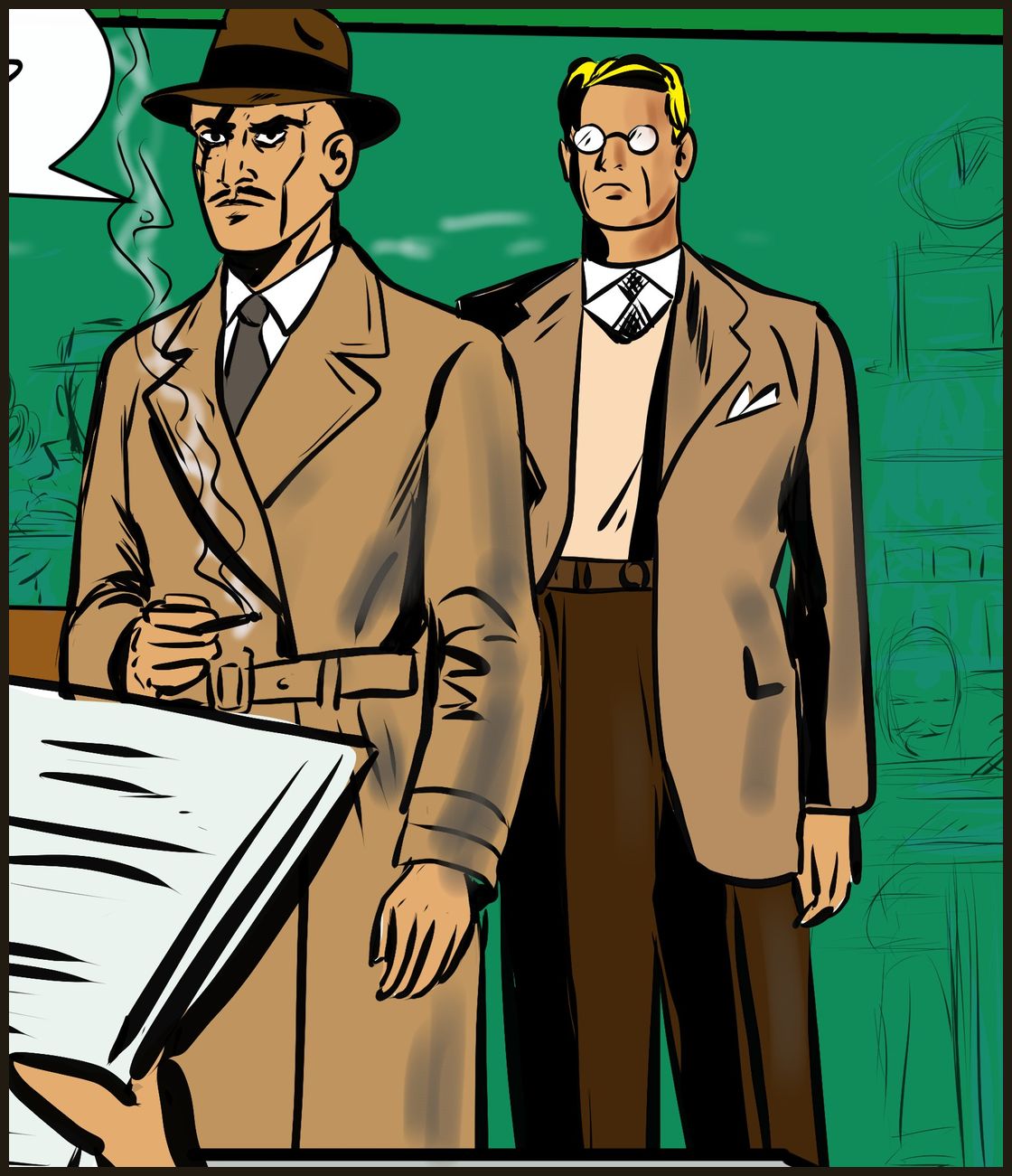
Two men entered. They wore pressed suits — dark blue, conservative cut, the kind of suits that came from government budgets rather than personal taste. One was tall with a jaw that looked like it had been designed by committee. The other was shorter, broader, carrying a leather briefcase that he held close to his body the way a man holds something that contains instructions rather than lunch. Neither of them looked at the truck driver or the couple or Sherri. Neither of them glanced at the menu board or the pie case or the coffee pot.
They walked straight to Frank's booth. No hesitation. No scanning the room. They knew exactly where he was, which meant they'd known exactly where he'd be.
The tall one gestured at the empty bench across from Frank. "Mind if we sit down, Mr. Zill?"
It wasn't really a question. Frank could tell by the way the man was already unbuttoning his jacket.
Sherri watched from behind the counter, her rag motionless for the first time all night. The radio crackled. Somewhere in Europe, the war continued without him.
Frank looked at the two men in their government suits and their purposeful eyes, and he felt something shift — not hope, not yet, but the absence of the certainty that nothing would ever change. A crack in the wall. Light from a direction he hadn't expected.
"It's a free country," he said. "Supposedly."
They sat.
Chapter 4 — The Offer
The tall one unbuttoned his jacket with the precision of a man who'd been taught that sitting in a buttoned jacket violated some regulation Frank had never heard of. He had the posture of a telephone pole — vertical, rigid, as if someone had replaced his spine with rebar during basic training and never bothered to put the original back. His jaw really was something. It looked like it had been designed by a committee of people who all agreed that jaws should be squarer, then taken one more vote just to be sure. His hands rested flat on the table, palms down, fingers together. No rings. Nails trimmed to the quick.
The shorter one was different. He moved like water finding its level — shifting in the booth, adjusting his position, his fingers tapping once against the leather briefcase before going still. His eyes were the busiest part of him. They'd already catalogued the gash above Frank's eye, the taped wrists, the canvas bag on the bench, the way Frank held his coffee mug — left hand, not right, which meant the right shoulder was the one that hurt. All of this registered in the time it took to settle into a vinyl seat.
Sherri materialized with the coffee pot. She didn't ask. She just poured — two cups, black, the ceramic clicking against the Formica with the practiced rhythm of a woman who could pour coffee in her sleep and probably had. Her eyes lingered on the tall one's haircut, which was military regulation, trimmed high and tight above the ears. Then on the shorter one's shoes, which were polished to a shine that no civilian maintained voluntarily. She set the pot down on the edge of the table, which she never did, which meant she wanted an excuse to come back.
"Anything to eat?" she asked. She was looking at Frank when she said it.
"We're fine," the tall one said.
"I wasn't asking you."
Frank shook his head. Sherri retreated behind the counter. Her rag stayed on her shoulder. Her eyes stayed on the booth.
The tall one reached into his jacket and produced a leather wallet that he opened with one hand and laid flat on the table. Inside, a photograph and a card — military identification, official issue, with the kind of stamp that came from offices where the furniture was bolted to the floor. The photograph showed the same face minus about ten years of whatever had carved those lines around his mouth.
"Sergeant Harold Haverchuck," he said. "United States Army."
The name landed on the table between them like a coin. Frank didn't pick it up. He looked at the ID without touching it, the way a man looks at a hand of cards he's not sure he wants to play.
The shorter one produced his own identification with less ceremony. He held it up, briefly, the way a commuter flashes a train pass — present but not lingering. "Corporal James Smith." His voice was quieter than Haverchuck's, set back in his throat, the kind of voice that made you lean forward to hear it, which was probably the point. A small notebook had appeared in his left hand. Frank hadn't seen him reach for it. A pencil hovered above an open page.
"Army," Frank said. He said it flat. No inflection. The word could have meant anything.
"That's correct."
"You always recruit at midnight in diners?"
Haverchuck's mouth did something that might have been a smile on a face with more practice. "We go where the candidates are, Mr. Zill."
*Candidates.* The word hung in the air like cigarette smoke. Frank's ribs throbbed. The butterfly bandages above his eye pulled with every micro-expression, reminding him that his face was held together with adhesive strips and stubbornness.
"How'd you find me?"
"We've been watching for some time." Haverchuck picked up his coffee. He didn't drink it. He held it the way a man holds a prop in a conversation he's rehearsed. "Everyone has a place they go when things go wrong. Yours is here."
Frank looked at the Sergeant. Then at Smith, who had written something in his notebook — a single line, quick and precise, the pencil barely touching the page before lifting away. Smith's eyes met Frank's, and there was something in them that Frank recognized from the ring. The look of a man who watched other men for weaknesses. Not malice. Just inventory.
The radio behind the counter changed its tone. The measured newscaster had been replaced by a woman reading casualty lists — names and ranks and hometowns, delivered in a voice carefully emptied of emotion, each name a stone dropped into still water. Private First Class So-and-So, of Somewhere, Ohio. Corporal Such-and-Such, of Nowhere, Indiana. The names fell like rain on a tin roof, steady and relentless and impossible to ignore.
Sherri turned the volume down. Not off. Down. The names continued, quieter now, background noise that was never really background.
The diner had emptied while Frank wasn't paying attention. The truck driver's plate sat at the counter, cherry filling congealing on white ceramic. The couple with the milkshake had vanished, leaving two straws in an empty glass. The neon PEN sign pulsed its broken red through the plate glass, painting the three men in the booth with light that came and went like a slow heartbeat.
"Look," Frank said. "Whatever you're selling—"
"We're not selling anything." Haverchuck set his coffee down. Untouched. "We're offering."
Smith turned a page in his notebook. The sound was small and crisp in the empty diner. He wrote something else. Frank watched the pencil move and wanted to reach across the table and break it.
"There's a difference?" Frank asked.
"There is to the men who accept."
Haverchuck leaned forward. His elbows rested on the table and his fingers laced together, and the gesture was so deliberate, so clearly drawn from a manual on How to Establish Rapport with Reluctant Assets, that Frank almost respected the transparency of it. Almost.
"Mr. Zill," Haverchuck said. "We didn't come here because of your match tonight. We came here despite it. We've been building a file on you for four months. Your physical conditioning. Your pain tolerance. Your ability to improvise under pressure." He paused. "Your father's service record."
Something cold moved through Frank's chest. Not the heart murmur. Something else.
"My father's dead."
"We know. Corporal Henry Zill, 77th Infantry Division. Argonne Forest, 1918. Awarded the Silver Star for gallantry in action." Haverchuck recited it the way the radio woman recited names — precisely, without emotion, each fact a stone. "He was a hell of a soldier, Mr. Zill."
Frank's jaw tightened. The butterfly bandages screamed. "Don't talk about my father."
Smith's pencil stopped moving. His eyes lifted from the notebook and settled on Frank with the patience of a cat watching a mouse hole. He said nothing. He didn't need to. The silence said it for him: *we know exactly which buttons to press, and we haven't even started.*
Haverchuck straightened. His hands unfolded and returned to their flat position on the table. He glanced at Smith. Smith gave the faintest nod — barely a movement, more like a thought made briefly visible.
"Mr. Zill," Haverchuck said. "My name is Sergeant Harold Haverchuck, and this is Corporal James Smith, and we are here on behalf of the United States Army to ask you a question that I promise you've never been asked before."
The radio murmured. Sherri's rag hung motionless on her shoulder. The neon pulsed. Outside, the street where the bus had been was empty now, just wet asphalt reflecting the diner's broken sign into the dark.
Frank looked at the two men across the table. His ribs hurt. His head hurt. His pride hurt worst of all. He wrapped his hands around his coffee mug — cold now, the ceramic offering nothing — and waited for the question.
# Scene 2
Haverchuck reached into the briefcase. His fingers moved through its contents with the deliberate care of a man who'd organized them in advance and knew exactly where everything was. He produced a manila folder — thin, government-issue, stamped with a classification mark that Frank couldn't read upside down — and opened it on the table between the coffee cups.
"Frank David Zill," Haverchuck read. "Born August fourteenth, 1909, Allentown, Pennsylvania. Mother Ingrid, née Kaufmann. Father Henry, deceased 1934. One sibling, a sister, deceased in infancy." He turned a page. "First application for military service, March 1941. Rejected. Pes planus, bilateral. Systolic murmur, grade two. Second application, September 1941. Rejected. Same grounds."
Frank's hands went flat on the table. His taped wrists looked like bandaged stumps in the diner's light. "Where did you get that?"
Haverchuck continued as if Frank hadn't spoken. "Professional wrestling career beginning 1931. Twelve years in the Eastern Seaboard territory. Win-loss record — well, we understand the wins and losses are predetermined, but your performance evaluations from promoters describe you as, and I quote, 'the most reliable worker in the territory' and 'a man who could carry a broomstick to a four-star match.'" He looked up. "I don't entirely know what that means, but I'm told it's a compliment."
"You've been spying on me."
"Evaluating."
"That's a nice word for it."
Smith's pencil moved. Frank caught it in his peripheral vision — a quick notation, three or four words, the pencil angled so that the page faced away. Smith's eyes hadn't left Frank's face during the entire exchange. He watched the way a jeweler watches a stone he's considering cutting, mapping the flaws and the facets with equal interest.
"Your wrestling contract with the Scranton territory," Haverchuck said, producing a second document. "Terminated as of tonight. Or rather, you terminated it by walking out. The promoter's already on the phone trying to reach you. He wants you back for the summer program." A pause. "We'd prefer you didn't take his call."
Frank leaned back in the booth. The vinyl squeaked against his coat. His ribs sang a chord of protest that started in his kidneys and ended somewhere behind his sternum. He looked at the folder, at the neat typed pages that contained his entire life reduced to facts and statistics, and he felt the specific violation of being known without being understood.
"What do you want?"
Haverchuck closed the folder. He placed both hands on top of it, fingers spread, as if holding it shut. "The United States Army is assembling a special operations team for a mission of national importance. The details are classified beyond what I can share in a diner in Scranton at midnight. What I can tell you is that we need men with a very specific set of capabilities."
"Soldiers."
"Not exactly." Haverchuck's jaw worked. The committee had designed it for clenching, and it performed admirably. "We need men who can take punishment and keep functioning. Men who can improvise when plans fail. Men who understand how to control a hostile crowd, how to read an opponent's body language, how to perform under extreme physical duress." He met Frank's eyes. "We watched your match in Pittsburgh six months ago. The one where your opponent dropped you on your neck — the real drop, the botched one — and you finished the remaining twelve minutes without the audience knowing anything had gone wrong."
"My neck was fine."
"Your neck was fractured. Hairline, C-4 vertebra. We obtained your medical records from the hospital in Pittsburgh. You wrestled four more matches that week before seeing a doctor." Haverchuck said this without admiration or judgment. He said it the way a mechanic describes an engine that shouldn't still be running. "That's what we need, Mr. Zill. Not a soldier. A man who doesn't stop."
The silence that followed had weight. Frank could feel it pressing against his eardrums, filling the space between the three men in the booth. Smith's pencil was still. Even Sherri's rag had stopped its phantom wiping.
Frank laughed.
It came out wrong — too sharp, too short, with an edge that could cut glass. It was the laugh of a man who'd heard the punchline before the joke. He shook his head, and the butterfly bandages pulled, and the pain behind his right eye flared like a struck match.
"You want a pro wrestler to fight a war."
"We want—"
"A man who pretends to fight. That's what I do, Sergeant. I pretend. I throw fake punches and take fake falls and the whole goddamn thing is rigged from the opening bell to the last three-count." He was quoting Sherri now, and he knew it, and it tasted like ash. "The Army told me I wasn't fit to serve. Twice. Flat feet. Bad heart. Now you're sitting in my booth telling me my fake job qualifies me for a real mission?" He leaned forward. The gash above his eye wept a single drop of blood that ran down to his eyebrow and hung there. "Pick a lane."
Haverchuck opened his mouth. Smith touched his arm — one finger, barely any pressure — and Haverchuck stopped. It was a small gesture, almost invisible, but it told Frank everything he needed to know about which of these two men was actually in charge.
"I tried to serve," Frank said. His voice had dropped. The anger was still there but it had changed shape, compressed into something dense and heavy that sat in his chest alongside the heart murmur that had kept him out of the fight. "I stood in line at the recruitment office with a hundred other men who wanted to go overseas and get shot at for their country. And a doctor with rimless glasses spent twelve seconds on me and stamped a piece of paper and sent me home. Twelve seconds. That's what I was worth to the United States Army."
He reached for his wallet. Pulled out two dollars — more than the coffee cost, more than three hours of booth rental warranted — and dropped them on the table. The bills landed on top of the manila folder, covering his name.
"Find somebody else."
He grabbed the canvas bag. Stood. His ribs punished him for it, a sharp, bright pain that made his vision narrow for a half-second before widening again. He didn't let it show. Twelve years of selling other men's offense had taught him that much.
The bell above the door jingled when he pushed through it. The sound was small and cheerful and completely wrong for the moment.
Rain. It had started while he'd been inside — a cold, steady rain that hit the sidewalk at an angle and found the gap between his collar and his neck immediately. The neon PEN sign reflected in the wet pavement, red light fracturing into streaks that looked like something bleeding. Frank turned up his collar with one hand, held the canvas bag against his chest with the other, and walked.
He didn't look back. The diner's plate-glass window glowed behind him, a warm rectangle in the dark, and inside it, two men in government suits sat in his booth with his cold coffee and his refusal, and the rain came down, and the street was empty, and Frank Zill walked into it like a man who had nowhere particular to go and no particular reason to get there.
Smith reached across the table and picked up Frank's coffee cup — the one Frank had been nursing for three hours, the one still carrying the ghost warmth of his hands — and drank from it. A long, unhurried swallow. He set it down on the Formica with a soft click and wiped his mouth with the back of his hand, and the gesture was so casual, so devoid of ceremony, that it almost disguised how deliberate it was. He was a man who took what was left behind. A man who saw abandoned things as available things.
Haverchuck watched him do it. A muscle in his jaw twitched — the committee's finest work, flexing involuntarily — but he said nothing about the cup. Instead, he turned his attention to the plate-glass window.
Frank's silhouette was already small, halfway down the block, leaning into the rain at an angle that favored his left side. The ribs. Even retreating, the man's injuries told a story to anyone trained to read them. The canvas bag was pressed against his chest like a child's security blanket, and his coat collar was up, and the rain was turning the sidewalk into a dark mirror that reflected the broken neon and the streetlamps and the shape of a man walking away from the last people who wanted to give him a purpose.
He turned a corner. Gone.
Haverchuck exhaled through his nose. It wasn't quite a sigh — sighing was civilian behavior — but it carried the same freight. He ran one hand over his cropped hair, palm flat, the way a man checks for damage he already knows is there. Twenty-some years in the Army had given him many skills. Patience with rejection wasn't one of them.
"You think he'll reconsider?"
Smith didn't answer immediately. He picked up the two dollar bills Frank had dropped on the manila folder and set them aside with two fingers, then opened the folder again. Looked at the photograph clipped to the inside cover — Frank's face, taken from a distance, grainy, the kind of surveillance photo that made everyone look guilty of something. He closed the folder and opened his notebook instead.
The notebook was small — palm-sized, black cover, the kind sold at any stationery store for a nickel. Inside, it was anything but ordinary. Smith's handwriting was precise and tiny, each letter formed with the mechanical consistency of a man who'd been trained to produce documents that other people would need to read in bad light. The pages were dense with information.
The current page held tonight's observations. *Height: 6'1". Weight: est. 215-220 lbs. Reach: approx. 76". Right-handed. Favors left when injured (right shoulder, likely rotator strain). Pain tolerance: exceptional — sustained open laceration above R. eye, continued functioning w/o visible impairment for 40+ min. Grip strength: significant (knuckle damage on both hands consistent w/ repeated striking of hard surfaces — lockers?). Psychological profile: pride-dominant, anger as secondary defense, isolation response to perceived betrayal.*
Smith turned back a page. Then another. Earlier entries, dated weeks and months before tonight. Notes from a match in Baltimore. A description of Frank lifting an opponent overhead with one arm while the other hung limp — *dislocated at the elbow per post-match medical report, self-reduced backstage*. Notes from a county fair in Maryland where Frank had worked a forty-minute match in ninety-eight-degree heat and then signed autographs for an hour afterward without sitting down. A line, underlined twice: *Does not quit. Does not know how to quit.*
Smith closed the notebook. The covers met with a crisp snap that cut through the diner's quiet like a small-caliber round. He looked up at Haverchuck with an expression that had rearranged itself from watchful neutrality into something almost pleasant. Not a smile, exactly. The faintest suggestion that a smile was being considered and might be approved pending review.
"Oh," Smith said. Quiet. The word barely reached across the table. "He will."
Haverchuck studied him. "What makes you so sure?"
Smith slid the notebook into his breast pocket and patted it once. "Because he didn't ask what the mission was." He picked up Frank's cup again, drained the last cold mouthful, and set it down with finality. "A man who doesn't care, doesn't listen. A man who listens, comes back."
Sherri appeared at the table's edge. She had the coffee pot in one hand and a check pad in the other, though neither seemed to be the real reason she'd crossed the floor. Her eyes moved between the two men the way they'd move between items on a shelf she suspected had been shoplifted.
"You boys friends of Frank's?"
"Associates," Smith said. The word was smooth and empty, a stone with no edges.
Sherri's mouth formed a line that communicated, with remarkable efficiency, that she did not believe him and did not appreciate being managed. "He's had a rough night."
"We're aware."
"Then maybe leave him alone for a while."
Smith stood. He buttoned his jacket — a mirror of Haverchuck's unbuttoning when they'd arrived, the gesture reversed and somehow colder. He reached into his pocket and placed coins on the table. The exact amount for two untouched coffees and one that had belonged to someone else. No more, no less. A tip calculated to be correct without being memorable.
Haverchuck gathered the manila folder and returned it to the briefcase. He clicked the latches shut. The sound was metallic, official, final — a briefcase that contained a man's life, snapped closed like a verdict.
They moved toward the door. Haverchuck first, Smith trailing. At the threshold, Smith paused. He turned and looked back at the corner booth — the vinyl still dented where Frank had sat, the coffee ring on the Formica, the two dollar bills sitting on the table like a statement nobody had asked for. His eyes lingered on the canvas bag's absence, the shape of where it had been.
Then his gaze moved to the radio on its shelf above the pie case. The newscaster had returned, reading a report about convoy movements in the North Atlantic. Troop ships. Submarine activity. The arithmetic of war, addition and subtraction performed in human units.
Smith's hand found the notebook in his breast pocket. He tapped it once through the fabric. The faintest expression crossed his face — not a smile, but the architecture of one, the scaffolding without the façade. The look of a man who had studied another man's breaking points and found them not just accessible but useful.
He stepped into the rain.
The bell above the door jingled. Cheerful. Wrong. Same as before.
Sherri stood alone in the diner. The clock above the counter read twelve-forty. The radio talked. The neon sign pulsed its incomplete word into the wet night. She picked up the coins Smith had left, counted them, and dropped them into her apron pocket with a sound like teeth clicking.
She looked at the corner booth. At the coffee ring. At the two dollars Frank had left, still sitting there, uncollected by the men who could have taken them.
"Trouble," she said, to nobody, to the empty diner, to the fluorescent lights that were still working here even if they'd died in a locker room across town. She picked up the coffee pot and poured what was left down the sink. The liquid was dark and bitter and had been sitting too long, and it circled the drain slowly before disappearing.
She turned off the radio. The names stopped.
Outside, the rain continued, falling on a street where three men had gone in three different directions, carrying three different versions of the same conversation, and only one of them knew how it was going to end.