Chapter 1 — The Belt
The locker room smelled like every locker room Frank Zill had ever dressed in — liniment, sweat, and the faint copper tang of old blood that no amount of bleach could kill. A high school gymnasium in Scranton, Pennsylvania. Dented lockers with combination locks that didn't work. A fluorescent tube flickered overhead like it was trying to die but couldn't commit.
Frank sat on a wooden bench that had been carved with decades of initials and obscenities. He'd stripped down to his trunks — royal blue with white stars, the kind of thing a man wore when his job was to make other men believe in something. His bare feet pressed against cold concrete. Somewhere beyond the cinderblock walls, a crowd was filling cheap folding chairs, buying watered-down beer and stale popcorn, and waiting for the biggest title match the Eastern Seaboard territory had seen in three years.
He started with the tape. Always started with the tape.
White athletic tape, half-inch, wrapped tight around the left wrist first. Three passes, smooth, no wrinkles. He'd learned this from an old-timer in Baltimore who'd said wrinkled tape was the sign of a man who didn't respect his own hands. Frank respected his hands. They'd carried him through twelve years of body slams, chair shots, and handshake deals made with men who had no intention of keeping their word.
Right wrist next. Same three passes. He flexed his fingers, made fists, released. The tape held. Good.
The boots came out of a canvas bag he'd been hauling since 1932. Red leather, white laces, blue soles. Custom-made by a cobbler in Philadelphia who'd thought he was putting together footwear for a circus act. Close enough, Frank had told him. The leather was cracked now, the soles worn thin in the balls where he pivoted for his finishing move, but they still fit like they'd been born on his feet. He laced them slowly, crossing right over left, pulling each eyelet snug. A man could blow out a knee from a loose boot. He'd seen it happen. Twice.
He reached into his bag and his fingers found the chain without looking. Thin gold, warm from being pressed against the canvas. The Star of David pendant was small — barely bigger than a thumbnail — but it carried weight that had nothing to do with metal. His mother had given it to him the night before his first match, pressing it into his palm with hands that already trembled.
*You wear this under your costume,* she'd said. *Nobody has to see. But you know. And God knows.*
Frank held it for a moment, the pendant resting in his taped palm. The All American. That was the name on the marquee. The gimmick. Red-blooded, apple-pie, Stars-and-Stripes Frank Zill, the pride of Pennsylvania. The crowds ate it up. They didn't need to know about the menorah in his mother's window or the Hebrew prayers she still whispered over Friday night candles when her mind allowed it.
He wrapped the necklace in a square of flannel cloth and placed it inside the bag's inner pocket. Zipped it shut. On match nights, the Star stayed hidden. Not because he was ashamed. Because some things were his and his alone, and this business had a way of taking everything that wasn't nailed down.
The locker door hung open on a bent hinge. Taped to the inside — held there by a strip of the same white athletic tape he used on his wrists — was a photograph. Black and white, creased down the middle, its edges soft from years of handling. His father stood in an Army uniform, young and lean and unsmiling, a doughboy's helmet tucked under one arm. Behind him, the blurred suggestion of French countryside. 1917.
Frank looked at the photograph the way a man looks at a mirror that shows someone better than himself.
His father had been a real soldier. Served in the Argonne. Took a piece of German shrapnel in his hip and walked with a limp for the rest of his life and never once complained about it. When Frank had tried to enlist — twice — the Army doctors had turned him away. Flat feet. A minor heart murmur. Nothing that stopped him from throwing men around a ring six nights a week, but apparently enough to keep him from throwing himself at the Kaiser's successors.
*You fight your own war,* his father had said, from the hospital bed where he'd spent his last months. *Doesn't have to look like mine.*
Easy words. Hard to swallow.
Frank closed the locker door. The hinge squealed.
The door to the locker room banged open like it owed somebody money.
Benjamin Bradley entered the way he entered every room — as if the room had been waiting for him and he was gracious enough to finally arrive. His robe was purple silk with gold trim, the kind of garment that looked like it had been designed by someone who'd heard about good taste but decided against it on principle. Sequins caught the dying fluorescent light and threw tiny sparks across the cinderblock walls. Underneath, his championship belt — the one Frank was supposed to win tonight — gleamed against his bare stomach like a second smile.
"You're not dressed yet," Bradley said, which was a lie, since Frank was clearly dressed. What he meant was that Frank wasn't *performing* yet.
"I'm dressed."
"You're sitting in a concrete box looking at your boots like they killed your dog." Bradley dropped onto the bench across from Frank, crossed his legs at the ankle, and began examining his fingernails. They were immaculate. They were always immaculate. "We go in forty minutes. You want to run through it?"
Frank nodded. "Top of the match, you work the arm. I sell big, crowd gets behind me—"
"I work the arm *and* the ribs. We talked about this. The rib work sets up the bearhug in the second act." Bradley's voice carried the precise diction of a man who'd trained himself out of a West Virginia accent through sheer force of will. Each word was placed like a chess piece. "You're selling the ribs for ten minutes. I hit the backbreaker at fifteen. Bearhug at twenty. You power out, hit the shoulder blocks, the slam, then the big elbow for the finish."
"I remember."
"You say that, but you also forgot to sell the leg in Pittsburgh and I looked like an idiot applying a figure four to a man who'd been sprinting."
Frank almost smiled. Almost. "That was six months ago."
"I have a long memory for people making me look stupid." Bradley's eyes were bright, sharp, calculating — the eyes of a man who tracked every detail because details were the difference between a good match and a great one. Behind the sequins and the swagger, Bradley was a craftsman. Frank knew it. Most people didn't bother to look past the robe.
Bradley stood, adjusted the championship belt on his shoulder with a practiced gesture that was half vanity and half genuine affection for the leather and gold. He looked at Frank — really looked at him — and for a moment, the performance dropped away. Just two men in a concrete room about to go to work.
"You ready for this?"
"Been ready for twelve years."
"Yeah, well." Bradley grinned, and there was something in it that was almost tender, though he'd have denied it under oath. "You owe me dinner after you win that belt. Somewhere nice. I'm not eating at another roadside diner."
"You'll eat where I take you and you'll like it."
"Unlikely." Bradley headed for the door, his robe swishing against his calves. He paused with one hand on the frame. "Frank."
"What."
"Good match tonight. Let's give them something to remember."
He was gone before Frank could answer. The robe's sequins left afterimages in the bad light, tiny ghosts that faded against the walls.
Frank sat alone. The crowd noise was building — a low, animal hum that vibrated through the floor and up through the bench and into his bones. He flexed his taped hands. Checked his laces one more time.
The biggest night of his career. Everything he'd worked for, every backwater gymnasium and county fair and half-empty armory, all of it leading to this moment in a high school in Scranton where the folding chairs didn't match and the ring ropes were slightly loose on the north side.
He didn't open the locker to look at his father's photograph again. He didn't need to. He knew every line of that face, every shadow, every crease in the paper.
Instead, he stood. Rolled his neck. Felt the vertebrae pop like distant firecrackers.
Time to go to work.
The curtain was a bedsheet. Somebody had stapled it to a wooden frame at the gymnasium's side entrance, and it served as the boundary between the backstage world where men planned their violence and the public world where they performed it. Frank pushed through and the noise hit him like a fist.
Six hundred people in a room built for four hundred. Folding chairs crammed so tight that the fans sat shoulder to shoulder, programs rolled into tubes they could wave or swat their neighbors with. The ring squatted in the center of the basketball court, its posts bolted to a raised platform that wobbled if you hit the ropes too hard on the south side. Bare bulbs hung from the gymnasium rafters on extension cords, casting the kind of light that made everything look like a crime scene.
None of it mattered. Not the venue. Not the budget. Not the bedsheet.
Frank wore the American flag across his shoulders like a cape, and six hundred people lost their minds.
He walked the aisle — really just a gap between two sections of folding chairs — with his arms raised, slapping outstretched hands. A kid in a flat cap nearly fell out of his seat reaching for him. An old man with a VFW pin on his lapel stood and saluted. Frank pointed at him, nodded. The gesture was rehearsed. The feeling behind it wasn't.
The ring felt solid under his boots when he climbed through the ropes. He mounted the second turnbuckle, spread his arms, and let the flag fall behind him like wings. The crowd roared. He could feel it in his chest — not just sound but pressure, a physical thing that pushed against his ribs and filled the empty spaces where doubt usually lived.
He saw her.
Front row. Dead center. Ingrid Zill sat in a folding chair that someone had tried to cushion with a stadium blanket. She wore a white T-shirt with THE ALL AMERICAN printed across the chest in red and blue letters — merchandise that Frank had paid to have made at a print shop in Allentown, fifty shirts at a time, sold out of a cardboard box at the door. The shirt was too big on her. Everything was too big on her now.
She was on her feet, clapping. Her mouth was moving.
"Go get 'em, Frankie!" she shouted. Then, quieter, to the woman sitting next to her — a neighbor Frank had paid five dollars to accompany his mother: "That's my boy. That's my Harold."
Harold. His father's name. Dead nine years.
Frank swallowed and turned away from the front row. He couldn't afford the weight of it right now. Not tonight. He bounced off the ropes, testing them, and waited.
Bradley's entrance was a production. Even in a high school gymnasium with a bedsheet for a curtain, the man made it feel like the Metropolitan Opera. He emerged in the purple robe, arms spread, chin tilted at an angle that suggested the crowd's hatred was a fragrance he found particularly intoxicating. The championship belt caught the bare-bulb light and threw it back in the faces of the people who booed him. He loved it. Every jeer was a valentine.
The bell rang. A real bell — brass, mounted on a post at ringside, struck by the timekeeper with a small hammer. The sound cut through the noise like a blade.
Bradley moved first. He circled, fingers extended, that theatrical sneer fixed in place. Then he lunged. His hand caught Frank's wrist and he wrenched it — armbar, textbook — and Frank felt the familiar burn in his shoulder as the joint stretched toward its limit. Scripted or not, the body didn't know the difference. Pain was pain.
Bradley worked the arm for five minutes, grinding it against the top rope, stomping the elbow, wrenching it behind Frank's back in a hammerlock that made Frank's vision blur at the edges. The crowd booed. Frank grimaced and sold every second of it, because that was the job — making people believe that what they were seeing was real, even when it wasn't, even when the outcome had been decided in a locker room twenty minutes ago.
Then came the ribs. Bradley drove his knee into Frank's midsection, folded him over a backbreaker across his thigh at the fifteen-minute mark, and the sound Frank made wasn't acting. His spine compressed and his kidneys screamed and he hung there, draped across Bradley's leg, staring at the gymnasium ceiling where someone had stuck a wad of gum to a rafter.
"Breathe," Bradley whispered, invisible to anyone more than two feet away. "You're doing great."
Frank breathed. The crowd chanted his name. His mother chanted his father's.
At twenty minutes, Bradley locked in the bearhug. His arms wrapped around Frank's damaged ribs and squeezed, and the crowd could see the compression, could see Frank's face contort, could see his arms going limp at his sides. The referee — a thin man with a bad combover and a shirt two sizes too tight — lifted Frank's hand. It dropped. Lifted it again. Dropped again. Lifted it a third time.
Frank's hand stayed up.
The gymnasium exploded.
He grabbed Bradley's head. One shot. Two. Three forearms to the temple — pulled, of course, but timed with the slap of his own thigh to create the sound of impact. Bradley staggered back. Frank bounced off the ropes and hit a shoulder block that sent Bradley sprawling. Hit the ropes again. Another shoulder block. The crowd was standing now, every last one of them, the folding chairs scraping and tipping as people surged forward.
Frank lifted Bradley — all two hundred and twenty pounds of him — onto his shoulders. The slam shook the ring. The turnbuckles rattled. A kid at ringside spilled his entire bag of peanuts and didn't care.
He climbed to the top rope. The crowd knew what was coming. Frank spread his arms — the same pose he'd hit during his entrance, the same wingspan, the American flag nowhere in sight now but somehow still present in the gesture — and launched himself into the air for the diving elbow that would finish the match and make him champion.
Ingrid was on her feet, tears on her cheeks, screaming a name that might have been his.
The lights flickered.
Not the slow dimming of a planned theatrical effect. This was a stutter — a violent, electrical hiccup that plunged the gymnasium into half-darkness for one second, two, then brought the bare bulbs back at full brightness. The crowd murmured. Frank landed the elbow, but his eyes had already moved to the entrance, to the bedsheet curtain that was rippling now, pushed from behind by something large.
Bradley felt it too. His eyes flicked to the aisle and then back to Frank, and for the first time all night, the script stopped talking.
Chapter 2 — The Screwjob
The bedsheet tore down the middle like something biblical.
The Borneo Wildman came through the gap sideways because the frame wasn't wide enough for his shoulders. He stood six-foot-four and carried two hundred and seventy pounds distributed across a frame that looked like it had been assembled from spare parts by someone who valued function over aesthetics. His face was painted — bone white base, black streaks under his eyes, red slashes across his cheeks in patterns that were supposed to evoke some unspecified tribal origin but really just evoked violence. He wore a vest made from animal hides stitched together with leather cord. His feet were bare.
In his right hand, a steel folding chair. The same kind the fans were sitting in.
He didn't walk down the aisle. He moved through it like a current through water, and the people in his path parted or got parted. A woman in a housecoat yanked her daughter sideways. A man with a beer tried to stand his ground and thought better of it when the Wildman's eyes found him — flat, dark, focused on something beyond any single person.
Two security guards converged from opposite sides. They wore yellow T-shirts that said STAFF and expressions that said they hadn't been paid enough for this. The first one grabbed the Wildman's arm. The Wildman shrugged, and the guard left his feet. Just left them. He hit a section of folding chairs and went down in a tangle of aluminum and cursing. The second guard fared worse — a forearm to the chest that dropped him straight back onto the concrete floor where he lay making sounds like a fish pulled from water.
In the ring, Frank was still on the mat. He'd landed the elbow on Bradley not five seconds ago. His body was on top of Bradley's. The referee was sliding into position. The count was right there, the three-count that would change his life, the title finally coming home after twelve years of —
He saw the Wildman.
The man was already at ringside, already gripping the bottom rope, already pulling himself under with a speed that shouldn't have been possible for someone that large. The steel chair scraped against the canvas as he dragged it in behind him.
Frank rolled off Bradley and got to his knees. His brain was performing two calculations simultaneously: the first was that this was not in the script, the second was that the Wildman was already swinging.
He turned to face the chair.
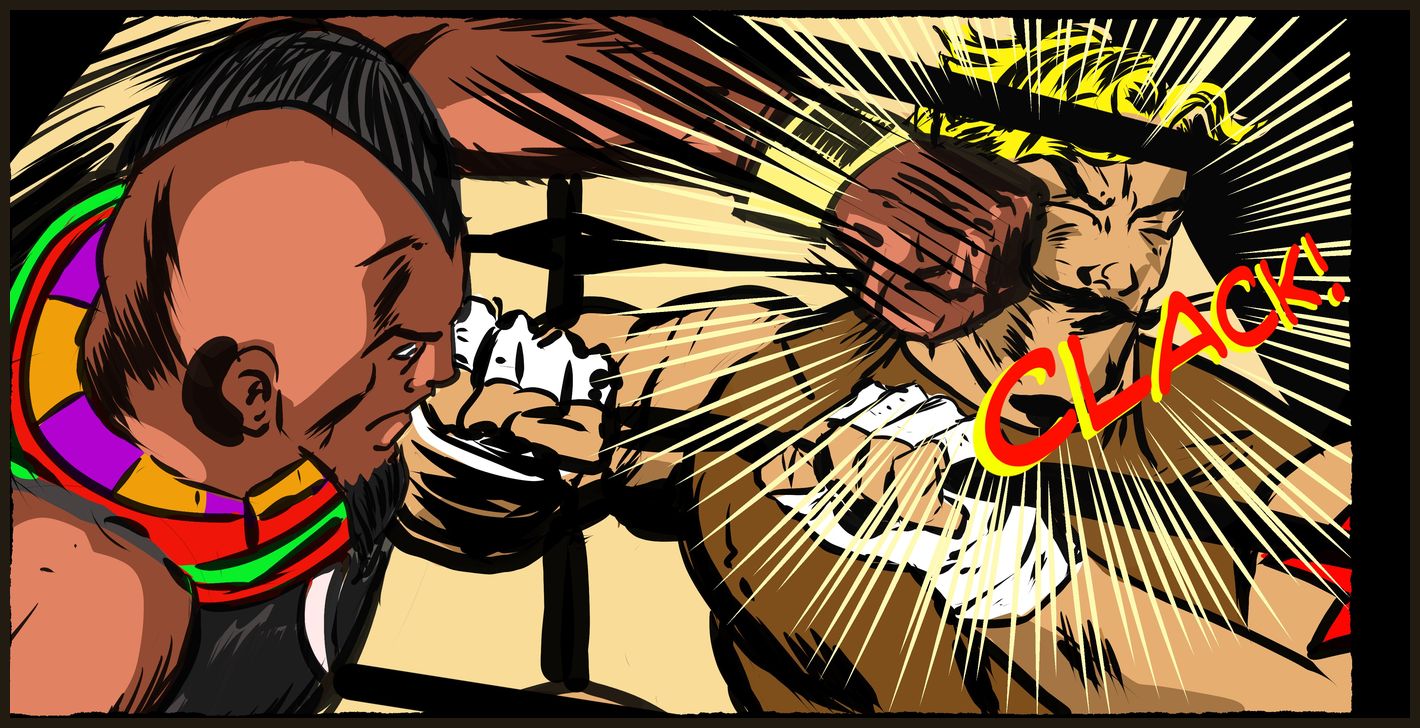
The sound was specific and terrible. Not the dramatic metallic crash that movies used. This was a flat, wet crack — steel meeting skull with nothing between them but skin and intention. The edge of the chair caught Frank above his right eye, and the gymnasium went white, then red, then sideways.
He hit the canvas face-first. His hands didn't even come up to break the fall. Blood came immediately, the way it always did from the forehead — a hot, eager rush that pooled in his right eye and turned half the world dark. The headband he wore had split. The skin beneath it had split with it, a two-inch gash that wept red onto the white canvas like a confession.
The crowd made a sound. Not cheering, not booing. Something older. The sound of six hundred people realizing at once that what they were watching had slipped its leash.
Bradley lay on his back where Frank had left him. His eyes were open, fixed on the ceiling, processing. The Wildman stood over Frank's crumpled body, the chair still in his hand, and Bradley saw the blood spreading on the canvas and something moved across his face — a ripple of genuine shock, maybe horror, maybe the particular nausea that comes from watching a man you've worked with for years get opened up for real.
He didn't move. Not right away.
The gymnasium was loud now. Confused loud. Angry loud. Somewhere in the front row, Ingrid Zill was trying to stand, her hands gripping the barricade, her neighbor pulling at her arm. "What are they doing to Harold?" she asked, her voice high and thin. "Why are they hurting my Harold?"
Bradley made his decision.
It happened in the space between heartbeats. The concern on his face — real, human, undeniable — flickered once and then was replaced by something smoother. The performer's mask. The champion's mask. He looked at Frank bleeding on the canvas, and he looked at the Wildman standing guard, and he understood what was happening even if he hadn't planned it, and what Benjamin "Breathtaking" Bradley understood, Benjamin "Breathtaking" Bradley used.
He rolled over. Draped one arm across Frank's chest. Hooked the leg.
The referee stared at him. A thin man with a bad combover and a shirt that was now flecked with someone else's blood. His hands trembled at his sides.
"Count," Bradley said. Quiet. Just for the ref.
The referee's palm hit the canvas.
One.
Frank's eyes were open but unfocused. The blood was in both of them now. The bare bulbs above him blurred into smears of yellow light.
Two.
He tried to lift his shoulder. His body sent back a memo that said the shoulder was no longer accepting requests.
Three.
The bell rang. That same brass bell, struck with that same small hammer. The sound traveled across the gymnasium and found every ear and meant something different to each one. To the timekeeper, it meant the match was over. To the crowd, it meant injustice. To Bradley, clutching the championship belt that someone had slid into the ring, it meant survival.
To Frank Zill, flat on his back in a high school gymnasium in Scranton, Pennsylvania, it meant the end of something he didn't yet have a name for.
The crowd turned. Cups sailed into the ring — paper, mostly, trailing arcs of soda and beer. Programs followed. Someone threw a shoe. The anger was real in a way the match hadn't been, a fury born from the specific American conviction that the rules should mean something, that the good guy should win, that the flag should be enough.
Bradley retreated up the aisle, the belt raised over his head in both hands like a trophy pulled from a fire. His face wore triumph. His eyes wore something else entirely. The Wildman walked behind him, a wall of painted flesh and animal hide, and the crowd screamed at them both but nobody — not one person — tried to stop them.
In the ring, Frank lay still. Blood pooled beneath his head in a shape that resembled nothing. The referee knelt beside him, pressing a towel to the gash, saying words that Frank couldn't hear because the ringing in his ears had replaced all other sound.
He turned his head. Slowly. The motion sent the gymnasium spinning.
Through the blood in his eyes, through the haze and the pain and the noise, he found the front row. Found his mother. Ingrid was still standing, still gripping the barricade, her face a map of confusion and fear and something else — a lucidity that cut through the dementia like a blade through gauze. For one terrible, clear moment, she knew exactly what had happened. She knew it was Frank, not Harold. She knew he'd lost. She knew he was hurt.
Then the moment passed, and her eyes clouded again, and she sat down slowly in her folding chair and asked her neighbor when the show was going to start.
Frank closed his eyes. The canvas was warm beneath him, warm with his own blood, and the bell's echo finally faded, and he understood with the absolute clarity that only comes from having something taken — he was never meant to win the belt. Not tonight. Not any night. The fix had been in before he'd wrapped his first strip of tape.
He lay there, and the lights buzzed overhead, and the crowd's anger washed over him like weather he could no longer feel.